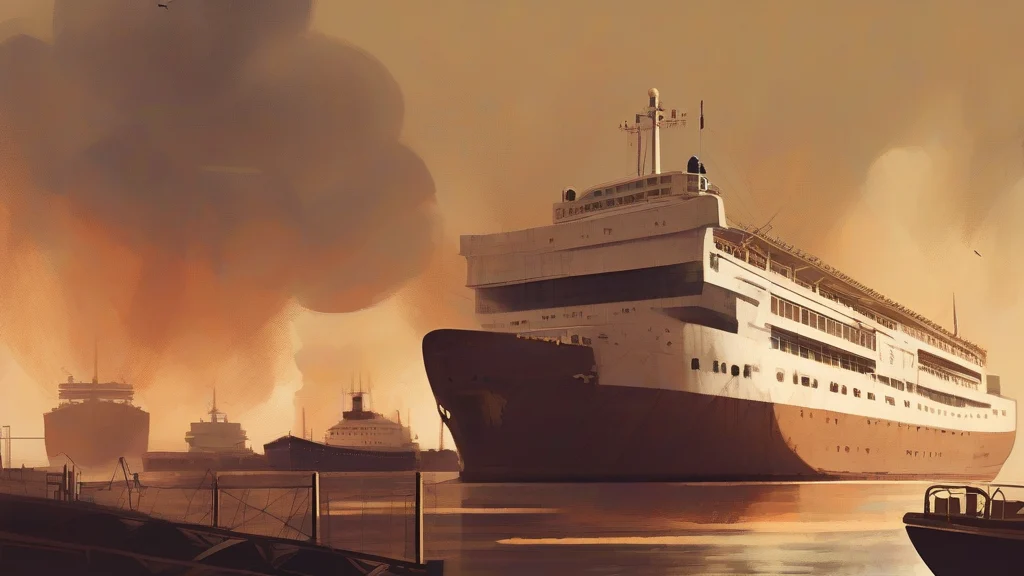
What does embarkment mean?
Embarkment is a noun referring to the act of boarding a ship, aircraft, or other vehicle at the beginning of a journey, whether by passengers or by cargo being loaded for departure. It derives from the verb 'embark', which traces back through French to Late Latin 'barca', meaning a small boat. In practice, embarkment is a relatively rare word: most writers and speakers use its more established synonym 'embarkation' instead, making 'embarkment' chiefly notable as a recognized variant form. It tends to appear in formal contexts such as maritime reports, military histories, travel documentation, and official notices about departures. A common point of confusion is with the far more frequent word 'embankment', which describes a bank of earth or stone built to support a road or hold back water; despite their visual similarity, the two words are entirely unrelated in meaning. Used correctly, embarkment evokes beginnings — the moment travelers step aboard and a voyage formally commences.
nounThe act of boarding a ship, aircraft, or other vehicle for the start of a journey. It is a less common variant of the standard word 'embarkation'.
- The act of passengers or cargo boarding a ship, aircraft, or other vehicle at the start of a journey.
"Passengers gathered at the pier in anticipation of the embarkment."
"The crew completed the embarkment of all passengers well before the scheduled departure time."
"Historians studied the records documenting the embarkment of troops bound for overseas service."
The plural is rare because the word usually denotes a single act or process; it may appear when referring to multiple separate boarding events.
"The log recorded all embarkments carried out at the harbor that season."
One misplaced vowel turns a journey into a wall of earth: 'embarkment' (going aboard) and 'embankment' (a bank of soil) differ by just a few letters but mean completely different things.
Reviewed by Deb Chak, Editor. AI-assisted content curated by RJS Tech Solutions LLP.
Etymology of embarkment
Embarkment comes from the verb 'embark', formed from the prefix 'em-' (from Latin 'in-') plus 'bark' or 'barque', meaning a ship or small vessel, which entered English via French from Late Latin 'barca'. The noun follows the common English pattern of forming action nouns from verbs with the suffix '-ment'. Its longer-established synonym 'embarkation' uses the '-ation' suffix borrowed through French and Latin, which likely explains why it became the dominant form.
How embarkment is actually used
'Embarkment' is considerably less common than its synonym 'embarkation', which is the preferred form in most modern usage. The word appears mainly in formal, maritime, military, and travel-related contexts. Writers should take care not to confuse it with the much more frequently used word 'embankment'.
Easily confused with embarkment
An 'embankment' is a wall or bank of earth or stone built to carry a road or railway or hold back water, whereas an 'embarkment' refers to the act of going aboard a ship or other vehicle.