What does embroidery mean?
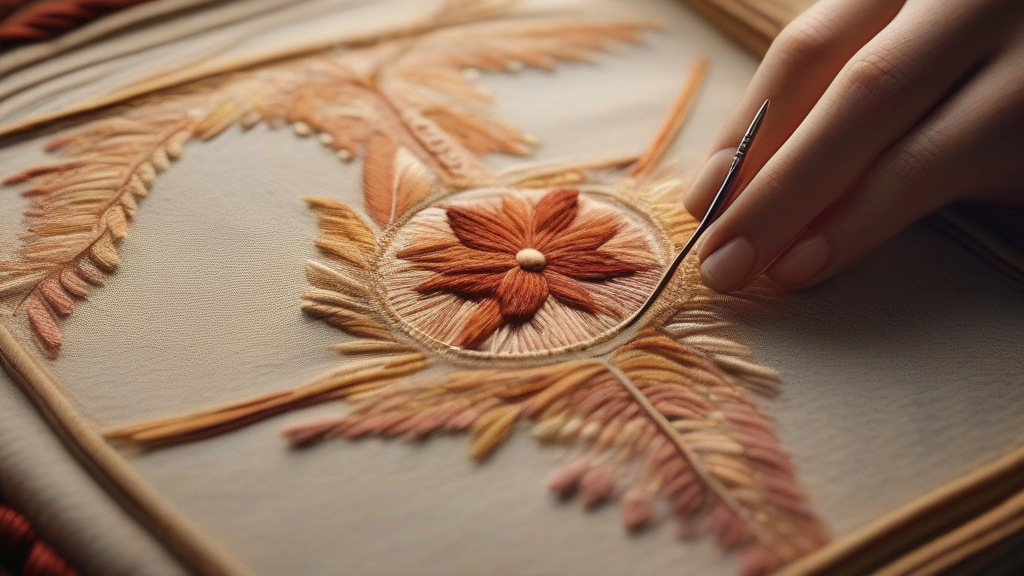
Embroidery is the art of decorating fabric using a needle and thread, with stitches worked into patterns, pictures, or lettering on cloth. It may also refer to the finished product itself — an embroidered piece such as a sampler, panel, or garment detail. The craft has existed for millennia across virtually every culture, from Chinese silk embroidery to European ecclesiastical work, and remains both a traditional handcraft and a contemporary art form. In everyday use, 'embroidery' can be uncountable (the practice) or countable (a specific work). The word also carries a figurative sense: to add 'embroidery' to a story is to embellish it with invented details, usually implying exaggeration. Common collocations include 'floral embroidery', 'hand embroidery', and 'intricate embroidery'. Related terms include needlework, needlepoint, and cross-stitch, though these are not exact synonyms — each names a specific technique within the broader family of decorative stitching.
nounThe art or craft of decorating fabric with needle and thread, using stitches to form patterns or pictures; also, a piece of work so produced. Figuratively, it refers to elaborate embellishment of language or detail.
- The craft of decorating fabric with needle and thread.
- A piece of decorated fabric so produced.
- Figurative: ornate embellishment of speech or writing.
"The cushion cover was adorned with delicate floral embroidery in silk thread."
"She spent months working the embroidery on her daughter's wedding dress by hand."
"His account of the trip was pure embroidery, with each retelling adding new flourishes."
The plural applies only to individual pieces of embroidered work, not to the craft itself, which is uncountable.
"The exhibition featured embroideries from across medieval Europe."
The Bayeux Tapestry — nearly 70 metres of 11th-century embroidery, not technically a tapestry at all — still tells the story of the Norman Conquest in stitched wool almost a thousand years later.
Reviewed by Deb Chak, Editor. AI-assisted content curated by RJS Tech Solutions LLP.
Etymology of embroidery
Embroidery comes from Middle English 'embrouderie', borrowed from Anglo-Norman, ultimately derived from Old French 'embroider' (to decorate with needlework). The prefix 'em-' comes from Latin 'in-', and the root relates to 'broiden', meaning to embroider or braid. The English verb 'embroider' shares this origin, and 'embroil' derives from the same Romance root relating to entangling or interweaving threads, which extended metaphorically to entangling people in conflicts.
How embroidery is actually used
Mostly neutral in register; used both as an uncountable noun for the craft ('she does embroidery') and countably for individual pieces ('an embroidery hung on the wall'). The figurative sense often carries a slightly negative connotation, implying exaggeration or embellishment of the truth.
Easily confused with embroidery
Embroidery is decorative stitching on fabric, while embroil means to involve someone in a conflict or difficulty.