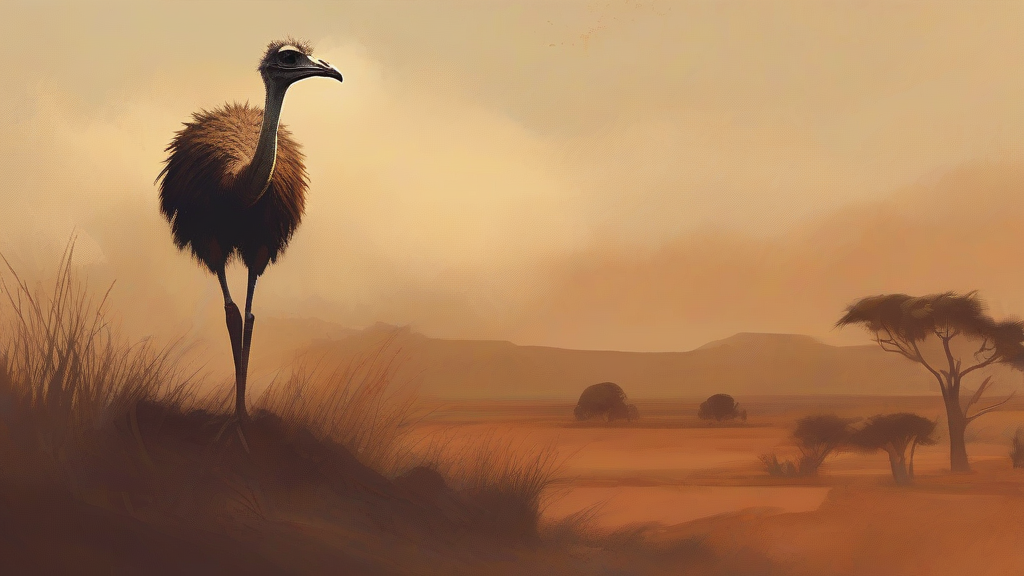
What does emeu mean?
An emeu is a large, flightless bird native to Australia, known today by the standard spelling "emu." Standing up to roughly two metres tall and covered in shaggy, double-shafted brown feathers, it has a long bare neck, small vestigial wings, and long, powerful legs that make it a fast and enduring runner. As Australia's largest native bird and the world's second-tallest after the ostrich, the emeu occupies a prominent place in Australian wildlife and culture, appearing on the national coat of arms. The spelling "emeu" reflects the word's earlier history in English, when several spellings competed before "emu" became fixed. Today "emeu" survives mostly in older texts, historical accounts, and period literature. Readers encountering it should understand it as a variant of "emu" rather than a separate animal, and modern writers would normally choose the shorter, established spelling.
nounA large flightless Australian bird with shaggy brown feathers, a long neck, and powerful running legs; the second-tallest living bird after the ostrich. "Emeu" is chiefly a historical or variant spelling of "emu."
- The emu: a large flightless ratite bird (Dromaius novaehollandiae) native to Australia.
- (historical spelling) The word as formerly written for the emu in older English texts.
"The explorers were startled by an emeu sprinting across the outback plain."
"An emeu can sprint at speeds approaching fifty kilometres per hour across open country."
"Nineteenth-century naturalists' journals often recorded sightings of the emeu alongside kangaroos."
The regular plural adds -s; when using the modern spelling, the plural is "emus."
"Several emeus grazed quietly near the waterhole at dawn."
Before it settled on one spelling, Australia's giant bird was written as "emeu," "emue," and more — a word borrowed through Portuguese and Dutch before English made up its mind.
Reviewed by Deb Chak, Editor. AI-assisted content curated by RJS Tech Solutions LLP.
Etymology of emeu
The word entered English in the late sixteenth or early seventeenth century, adapted through Portuguese "ema" — originally used for a crane or large bird — likely via Dutch intermediaries. Early English writers spelled it in various ways, including "emeu," "emue," and "ewne," before "emu" became the settled form. It belongs to the family Dromaiidae among the ratites, the group of flightless birds that also includes ostriches, rheas, cassowaries, and kiwis.
How emeu is actually used
The spelling "emeu" is now largely historical; contemporary writing uses "emu." The plural is typically "emus," though the older spelling sometimes took the plural form "emeus." The word carries no strong register connotation and appears mainly in ornithological, historical, or literary contexts.
Easily confused with emeu
"Emeu" is simply an older or variant spelling of "emu," the same large Australian bird; modern usage strongly prefers "emu."