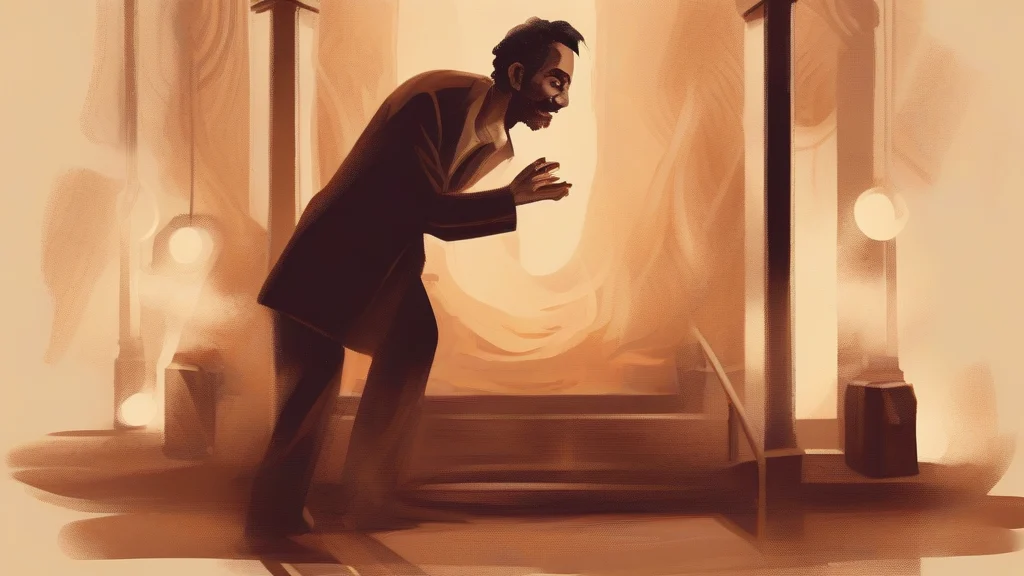
What does emote mean?
"Emote" is a verb meaning to express emotion, particularly in a dramatic, exaggerated, or theatrical way. It is most often applied to actors whose performances favor visible feeling — trembling voices, sweeping gestures, glistening eyes — over restraint, though it can also describe anyone who displays their feelings openly. The word frequently carries a mildly critical edge: to say someone is emoting suggests performance rather than genuine spontaneity. Interestingly, "emote" did not descend directly from classical roots as a verb; it arose in the early twentieth century as a back-formation from the older noun "emotion," coined by trimming the "-ion" ending on the assumption that such a noun must imply a verb. This makes it a favorite example among linguists of how English speakers invent words by analogy. Useful in reviews, criticism, and casual description alike, it fills a gap no single synonym quite covers.
verbTo express emotion, especially in an exaggerated or theatrical manner, as an actor does on stage.
- (of an actor or performer) to express emotion in a dramatic or theatrical way
- (more generally) to display one's feelings openly, sometimes with a connotation of excess or self-consciousness
"The young actor tended to emote wildly rather than trust the quiet power of the script."
"In the final act she finally stopped acting and simply began to emote, tears streaming as the audience held its breath."
"He's not one to emote in public, but his voice cracked when he thanked the team."
"Emote" is a back-formation — English speakers invented it by chopping the "-ion" off "emotion," assuming that if there's a noun, a verb must lurk inside it.
Reviewed by Deb Chak, Editor. AI-assisted content curated by RJS Tech Solutions LLP.
Etymology of emote
"Emote" originated in English in the early twentieth century as a back-formation from the noun "emotion." The noun itself comes from Latin "emovere," meaning "to move out, stir up, or agitate," formed from the prefix "e-/ex-" (out) and "movere" (to move). Because "emotion" had been borrowed wholesale from Latin-derived French without a corresponding English verb, speakers constructed "emote" by analogy with pairs like "act/action." Its cousins through the same root include "move," "motion," "motivate," and "mobile."
How emote is actually used
"Emote" often carries a slightly critical or wry connotation, implying that emotion is being displayed performatively rather than felt spontaneously. It is common in theater criticism and informal commentary on expressive behavior, but less common in everyday speech than its parent noun "emotion."
Easily confused with emote
"Demote" means to lower someone in rank or position, while "emote" means to express emotion theatrically — the words look and sound similar but share nothing in meaning.