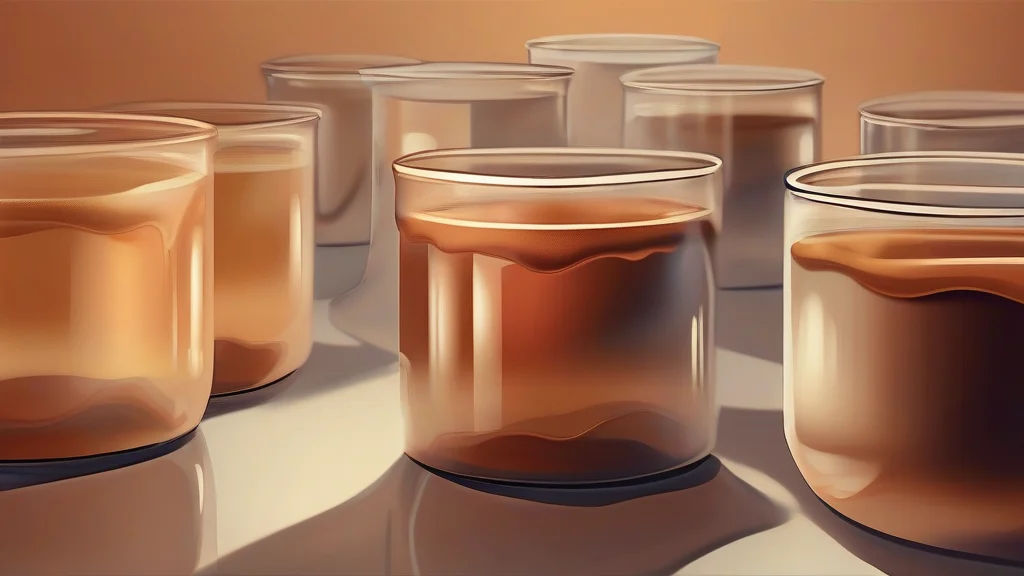
What does emulsifying mean?
To be emulsifying is to bring together two liquids that would otherwise refuse to mix — most famously oil and water — and hold them in a smooth, stable blend known as an emulsion. The word is the present participle of "emulsify", and it describes both the action itself and, when used as a gerund, the technique: emulsifying is what happens when vigorous whisking, blending, or an added stabilizer breaks fat into microscopic droplets suspended evenly through water. It is indispensable vocabulary in cooking (mayonnaise, Hollandaise sauce, salad dressings), cosmetics (creams and lotions), and pharmaceuticals, where an "emulsifying agent" such as lecithin, mustard, or egg yolk does the binding work. The word carries a precise, slightly technical flavor rather than any emotional connotation, and its figurative reach is limited — though writers occasionally use it to describe harmonizing things that seem incompatible, much like the mixtures it literally creates.
verbThe present participle and gerund of "emulsify": to combine two liquids that do not normally mix, such as oil and water, into a stable mixture called an emulsion, typically by stirring vigorously or adding an emulsifying agent.
- (Of a process or agent) To disperse two immiscible liquids, such as oil and water, into each other so as to form a stable emulsion.
- (Gerund) The act or technique of forming an emulsion, especially in cooking, cosmetics manufacture, and pharmaceutical preparation.
"Whisking the mustard into the olive oil slowly is the key to properly emulsifying the vinaigrette."
"Lecithin in egg yolks works by emulsifying the oil droplets into the vinegar."
"The chemist tested several surfactants before finding one capable of emulsifying the silicone-based fluid."
"Emulsify" comes from the Latin for "to milk out" — every mayonnaise you've ever whisked owes its existence to an ancient metaphor about milking a cow.
Reviewed by Deb Chak, Editor. AI-assisted content curated by RJS Tech Solutions LLP.
Etymology of emulsifying
The verb "emulsify" was formed in the 19th century from "emulsion", which derives from New Latin emulsum, the past participle of Latin emulgere meaning "to milk out" — from ex- (out) plus mulgere (to milk). The underlying image is of drawing liquid out drop by drop, much as milk is drawn from a cow; indeed, early uses of "emulsion" described milky fluids extracted from plants and animals. The Latin root mulgere is itself related to the English word "milk" through their shared Indo-European ancestor, making "milk" a distant cognate.
Related word forms
How emulsifying is actually used
Register is neutral-to-technical: common in cooking writing, food science, chemistry, and cosmetic formulation, but rare in casual conversation, where people usually say simply that they are "blending" or "mixing" ingredients. In scientific contexts it often appears with "agent" or "properties".
Easily confused with emulsifying
Evaporating turns a liquid into vapor, whereas emulsifying disperses one liquid throughout another to form a stable mixture.