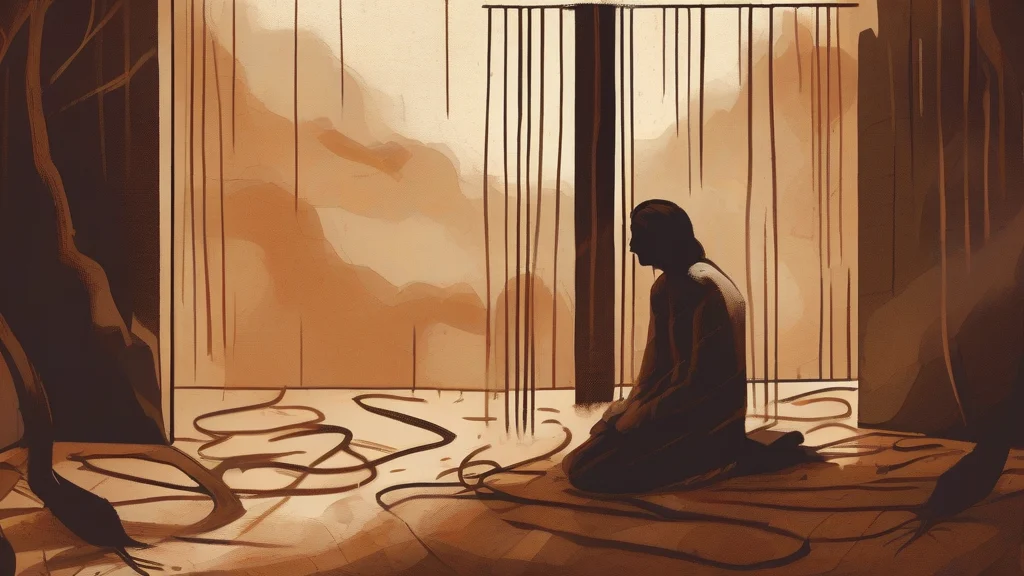
What does enmeshment mean?
Enmeshment is a noun describing the condition of being deeply caught up or entangled in something, much as a fish is caught in a net. It is most often applied to situations that are difficult to escape—debt, conflict, legal trouble, or complicated relationships—as in 'his enmeshment in the scandal.' The word has also become a key term in family psychology, where 'family enmeshment' names a dysfunctional dynamic in which personal boundaries between relatives dissolve, leaving individuals unable to develop separate identities or make autonomous choices. Unlike simple involvement, enmeshment implies confinement and loss of independence, and it almost always carries negative connotations. It derives from the verb enmesh, formed from 'en-' plus 'mesh,' the Old English word for a net, giving the term its vivid image of being snared in woven cords. Its precision makes it valuable for writers discussing both tangled circumstances and tangled relationships.
nounThe state or condition of being deeply entangled or caught up in something, especially a situation that is difficult to escape. In psychology, it refers to an unhealthy pattern of over-involvement between family members in which personal boundaries are blurred.
- The state of being deeply entangled or caught up in something difficult to escape, such as debt, conflict, or intrigue.
- A psychological pattern, typically within families, in which personal boundaries are so weak or blurred that individuals' identities and emotions become excessively intertwined.
"Her growing enmeshment in the company's financial affairs made it impossible to remain neutral."
"Years of enmeshment in the family business left him unable to pursue his own ambitions."
"The therapist helped them recognize how their enmeshment prevented both mother and daughter from developing independent lives."
Rarely used in the plural; the uncountable singular form is strongly preferred, since enmeshment denotes a state rather than countable items.
"The memoir catalogues the author's various enmeshments with powerful figures."
Enmeshment literally means being caught in a mesh—a net—and family therapists borrowed that image to describe relatives so tangled up in each other's lives that no one can tell where one person ends and another begins.
Reviewed by Deb Chak, Editor. AI-assisted content curated by RJS Tech Solutions LLP.
Etymology of enmeshment
Enmeshment derives from the verb enmesh, formed in English by adding the prefix 'en-' ('to cause to be in') to 'mesh,' meaning a net. The word 'mesh' traces back to Middle English, ultimately from Old English 'max,' meaning a net or looped structure. The suffix '-ment' then turned the verb into a noun denoting the resulting state of being ensnared. The word's core metaphor—that of being physically caught in a net—has remained central to its meaning from early use to the present.
Related word forms
How enmeshment is actually used
The word is somewhat formal in general usage but is standard terminology in family therapy and psychology literature, where 'family enmeshment' describes dysfunctional boundary-blurring within close relationships. It carries a negative connotation, implying unwanted or unhealthy entrapment rather than mere involvement.
Easily confused with enmeshment
Entanglement broadly means being twisted together or involved in something complicated, while enmeshment more strongly suggests being caught in a confining web—literally like a net—and is the standard term for blurred personal boundaries in family psychology.