What does ennead mean?
An ennead is a group, set, or collection consisting of nine members, whether people, objects, ideas, or deities. The word derives from the Greek "enneas," meaning nine, and carries a distinctly learned, classical tone that sets it apart from ordinary counting language. Its most celebrated application is historical and religious: in ancient Egypt, the Great Ennead referred to the nine principal gods worshipped at Heliopolis, a divine assembly central to that culture's creation mythology. Outside this context, "ennead" appears chiefly in scholarly, philosophical, or literary prose where a writer seeks precision or elegance — for example, describing nine principles, nine books, or nine figures arranged as a unit. Because it is rare in casual conversation, using it well signals erudition, though writers should reserve it for contexts where its formality suits the register.
A group or set of nine people or things.
"Her anthology gathered an ennead of essays on modern ethics."
Formal register; often found in academic and literary contexts.
(Capitalized, in ancient Egyptian religion) The nine principal deities worshipped at Heliopolis, collectively known as the Great Ennead.
"The Pyramid Texts invoke the Great Ennead as witnesses to the king's ascent."
The plural is regular. When referring to the Egyptian deities, the singular capitalized form is standard even when discussing the group collectively.
"Different city cults each maintained their own enneads of patron gods."
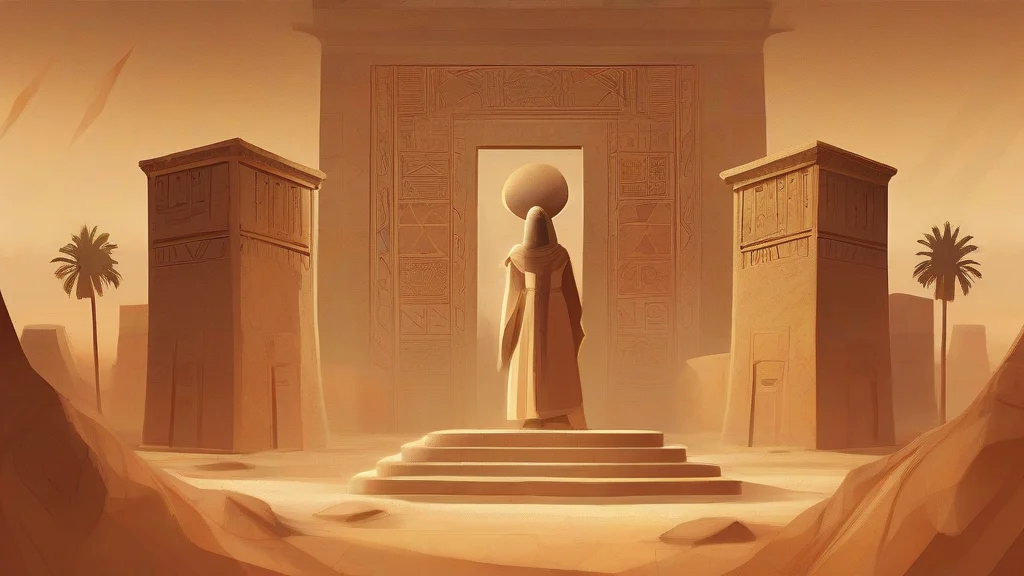
The ancient Egyptians organized their chief gods of Heliopolis into an ennead — a divine committee of exactly nine — giving this Greek-derived word one of its most famous uses.
Reviewed by Deb Chak, Editor. AI-assisted content curated by RJS Tech Solutions LLP.
Etymology of ennead
"Ennead" comes from the Greek "enneas," meaning "a group of nine," itself formed on "ennea," the Greek word for the number nine. The term entered English in the sixteenth century, initially through translations of classical and biblical scholarship. Its cognates include "enneagram," the nine-pointed figure used in personality typology, and "enneagon," a polygon with nine sides, all sharing the same Greek numerical root. The word's most enduring association is with the Great Ennead of Heliopolis in ancient Egyptian religion, a grouping popularized in English through Egyptological writings.
How ennead is actually used
"Ennead" is a formal, scholarly term, encountered mainly in academic, historical, or literary writing rather than everyday speech. Its most prominent specific use is as a proper noun referring to the nine principal deities of the Heliopolis cosmogony in ancient Egyptian religion. It is capitalized when used in that religious sense.
Easily confused with ennead
An enneagram is a nine-pointed geometric figure used in personality typology, while an ennead is simply any group or set of nine.
A nonet is a group of nine people or things, especially a musical composition for nine performers, whereas an ennead is the more formal, classical term for any set of nine.