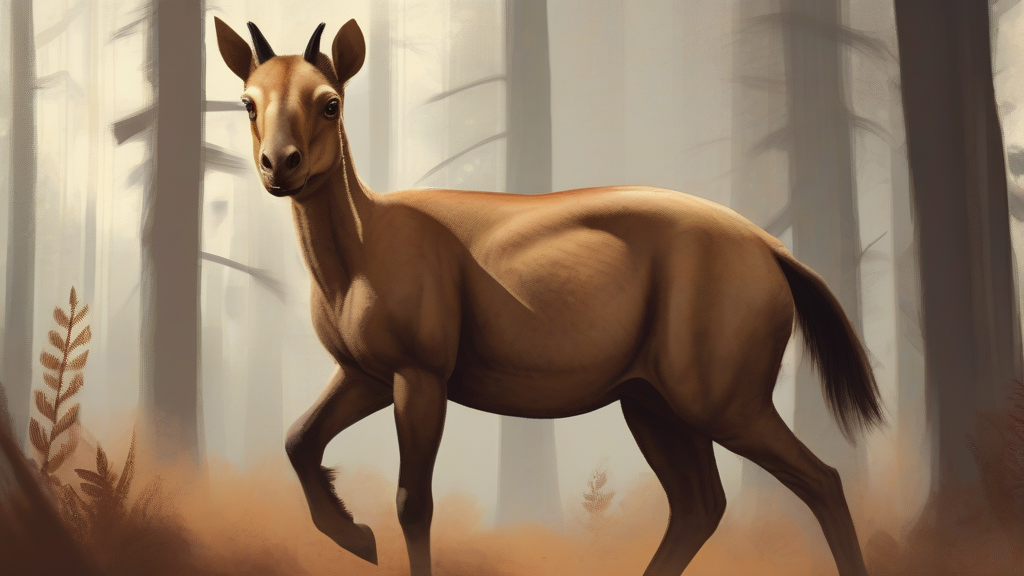
What does eohippus mean?
The eohippus was a small, extinct, hoofed mammal that lived roughly 55 million years ago during the early Eocene epoch and is widely regarded as one of the earliest known ancestors of the modern horse. Often nicknamed the "dawn horse," it stood only about a foot tall at the shoulder, bore four toes on its front feet and three on its hind feet, and browsed on soft vegetation in the forests of North America and Europe. Its fossils, first described in the nineteenth century, became central to classic accounts of equine evolution, illustrating a gradual transition from a small multi-toed browser to the large single-hoofed grazers of today. Many paleontologists now classify the animal under the older genus name Hyracotherium, treating Eohippus as a synonym, but eohippus remains the more familiar popular term. The word appears chiefly in scientific, educational, and natural-history contexts rather than everyday conversation.
nounAn extinct small early horse-like mammal of the genus Eohippus (now often classified as Hyracotherium), which lived in the early Eocene epoch about 55 million years ago and is regarded as one of the earliest known ancestors of the modern horse.
- The extinct early Eocene mammal regarded as the earliest known ancestor of the horse, a small four-toed animal roughly the size of a small dog.
"The fossil of an eohippus, barely the size of a fox terrier, revealed how dramatically horses have evolved over millions of years."
"Museum visitors were astonished to learn that the eohippus, ancestor of the mighty modern horse, was no bigger than a house cat."
"In her lecture on equine evolution, she traced the lineage from the tiny eohippus through Merychippus to today's thoroughbred."
As a Latinized scientific name, it may also be pluralized in pseudo-Latin fashion as "eohippi," but "eohippuses" is the standard English plural; when referring to multiple species of the genus, "species of Eohippus" is often preferred in formal writing.
"Fossils of eohippuses have been unearthed across the western United States, each adding detail to the picture of equine origins."
The eohippus — the 'dawn horse' — stood only about a foot tall at the shoulder and had toes instead of hooves: your car would dwarf it today.
Reviewed by Deb Chak, Editor. AI-assisted content curated by RJS Tech Solutions LLP.
Etymology of eohippus
The word eohippus comes from New Latin, formed from the Greek elements eos, meaning "dawn," and hippos, meaning "horse" — hence "dawn horse," a reference to its status as the earliest known member of the horse lineage. It was coined in the late nineteenth century as a scientific genus name for early Eocene horse fossils discovered in North America. The same Greek roots appear in other English words: eocene uses eos for the "dawn" epoch, while hippodrome and hippopotamus share the element hippos.
How eohippus is actually used
A technical or scientific term used mainly in paleontology, natural history writing, and educational contexts; it is rare in everyday speech. The name refers specifically to fossils from the early Eocene of North America (and related forms in Europe). Because many scientists treat Eohippus as a junior synonym of Hyracotherium, careful writers may note this taxonomic debate.
Easily confused with eohippus
Hyracotherium is the earlier-published scientific genus name that many paleontologists consider to refer to the same animal as Eohippus; eohippus is the more familiar popular term.
Mesohippus is a later, larger extinct horse ancestor from the Oligocene epoch, whereas eohippus is the much smaller earliest form from the Eocene.