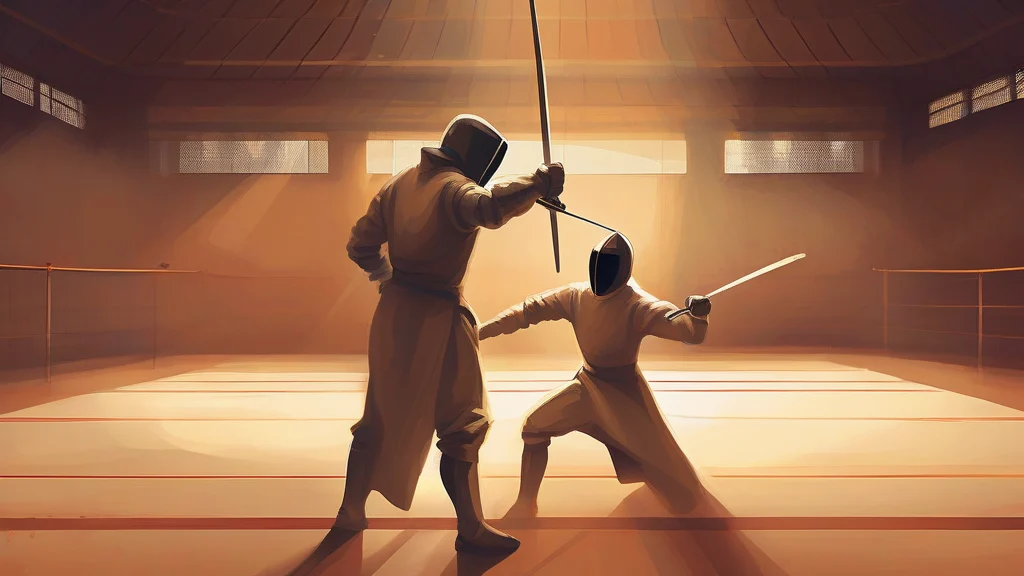
What does epee mean?
An epee is one of the three weapons used in the modern sport of fencing, alongside the foil and the sabre. It is a straight, stiff-bladed sword with a large, bell-shaped hand guard and a blunt, buttoned tip that registers touches electrically. The epee descends directly from the duelling swords of earlier centuries, and it preserves the most realistic assumptions of a duel: the entire body is a legal target, and there is no 'right-of-way' rule, so simultaneous touches score for both fencers. Because it rewards patience, precision, and timing rather than speed alone, many consider it the most cerebral of the three weapons. Outside the sporting context, the term can refer historically to the pointed civilian swords worn by European gentlemen from roughly the seventeenth century onward. The word comes from French épée, meaning 'sword', and is often written with the accent in formal texts, though the plain English spelling is entirely standard.
nounA heavy, blunt-pointed fencing sword with a bell-shaped guard, used in the sport of épée fencing, in which the entire body is a valid target area. Also, more broadly, any sharp-pointed duelling sword of a similar kind.
- The heaviest of the three modern fencing weapons: a stiff-bladed, bell-guarded sword used for point-only scoring with no right-of-way convention.
- (Historical) A sharp-pointed duelling sword, especially the French small-sword worn as part of civilian dress from the 17th century onward.
"She won the national championship in epee after a tense final bout decided by a single touch."
"He took up epee at university and quickly discovered he preferred its slower, tactical pace to sabre's frantic exchanges."
"The museum displayed an ornate 18th-century epee once carried by a French courtier."
Regular plural formation. The accented spelling 'épées' also occurs but is less common in everyday English usage.
"The club provided epees for all the beginners, so no one needed to buy their own equipment."
In epee fencing there's no right-of-way rule — if you both hit at the same time, you both score. It's the only fencing weapon where the whole body, from mask to toe, counts as a target.
Reviewed by Deb Chak, Editor. AI-assisted content curated by RJS Tech Solutions LLP.
Etymology of epee
The English word 'epee' was borrowed from French épée, meaning simply 'sword', which itself developed from Latin spatha, a term for a broad, flat-bladed sword adopted into Latin from Greek spathe. The same Latin root produced cognates across Romance languages, including Italian spada and Spanish espada. English adopted the French term in the nineteenth century specifically to denote the duelling-style sword used in fencing, distinguishing it from the foil and sabre.
How epee is actually used
Often written with an accent (épée) reflecting the French origin; the unaccented spelling 'epee' is fully acceptable in English. The word carries a slightly formal or sporting register — it appears mainly in contexts of fencing, Olympic sport coverage, or historical writing about duels. Capitalised forms such as 'Epee' appear as the official name of the event in competition listings.
Easily confused with epee
The foil is a lighter fencing weapon with a smaller guard, restricted to hitting only the torso, whereas the epee allows hits anywhere on the body and has no right-of-way rule.
The sabre is a cutting weapon scored with the edge as well as the point and targets everything above the waist, while the epee is thrust-only with the whole body as target.