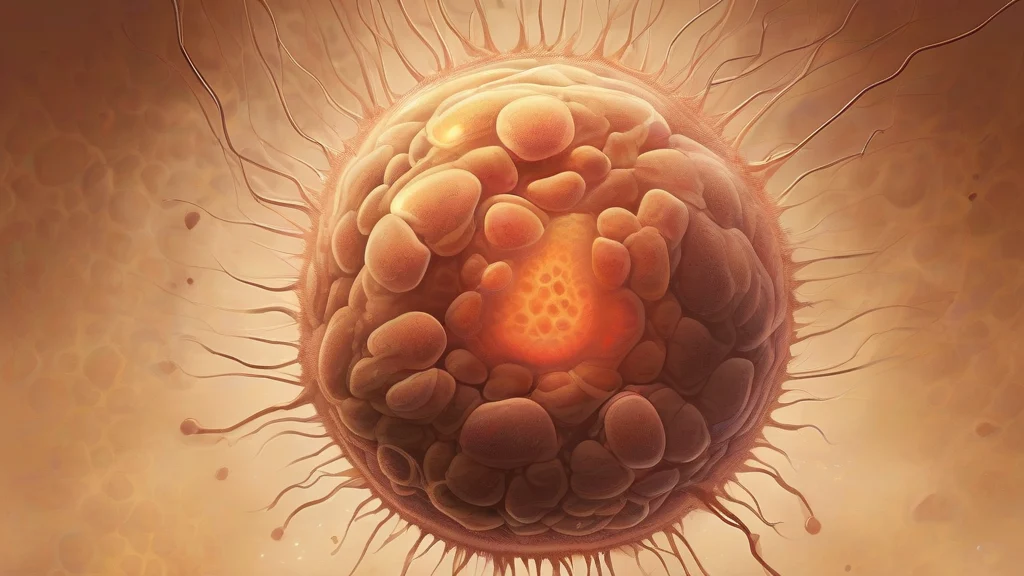
What does epiblast mean?
The epiblast is the outermost layer of cells in the early embryo — specifically, in mammals, the upper sheet of the bilaminar disc within the blastocyst. It is arguably the most consequential structure in development: every tissue and organ of the body arises from epiblast cells, which during gastrulation move through the primitive streak and differentiate into the three germ layers (ectoderm, mesoderm, and endoderm). Its counterpart, the hypoblast, lies beneath it and contributes mainly to extraembryonic structures rather than the fetus itself. The word is strictly technical, belonging to the vocabulary of embryology, developmental biology, and reproductive medicine, and would rarely be encountered outside scientific writing. Understanding the term is useful for anyone reading about stem-cell research or early pregnancy, since much modern work on pluripotent stem cells is framed around recreating the properties of the epiblast in the laboratory.
nounThe outermost layer of cells in the mammalian blastocyst, which gives rise to the embryo proper and some extraembryonic tissues. More broadly, the superficial layer of a developing embryo that forms the ectoderm.
- The outer layer of cells in a mammalian blastocyst that gives rise to the embryo proper and, through gastrulation, to all three germ layers.
- The superficial germinal layer of an early vertebrate embryo, equivalent in broad terms to the future ectoderm.
"The epiblast gives rise to all three germ layers during gastrulation."
"During gastrulation, cells migrate inward through the primitive streak, transforming the epiblast into the three definitive germ layers."
"The researchers labeled epiblast cells with a fluorescent marker to track their fate as the embryo developed."
The plural is used when referring to the epiblasts of multiple embryos or species; in practice the singular is often preferred even in generic statements.
"Comparative studies of mouse and human epiblasts have revealed striking differences in early patterning."
Every organ in your body — brain, bones, blood — traces back to a single sheet of cells called the epiblast.
Reviewed by Deb Chak, Editor. AI-assisted content curated by RJS Tech Solutions LLP.
Etymology of epiblast
Epiblast comes from Greek roots: 'epi-' meaning 'upon' or 'over', and 'blastos' meaning 'germ' or 'sprout'. The term was coined in the nineteenth century by embryologists studying early vertebrate development, alongside its counterpart hypoblast ('under-germ'). It shares the '-blast' element with related embryological terms such as blastocyst, blastula, and mesoblast.
How epiblast is actually used
A technical term confined almost entirely to developmental biology and embryology; it is not used in everyday speech. In mammalian embryos it specifically denotes the upper layer of the bilaminar disc, contrasted with the hypoblast beneath it. The term appears chiefly in academic and clinical literature rather than popular science writing.
Easily confused with epiblast
The hypoblast is the inner cell layer of the early embryo that contributes to extraembryonic structures, whereas the epiblast is the outer layer that forms the embryo itself.
The epiblast is the pre-gastrulation cell layer from which the ectoderm (along with mesoderm and endoderm) later derives.