What does equerry mean?
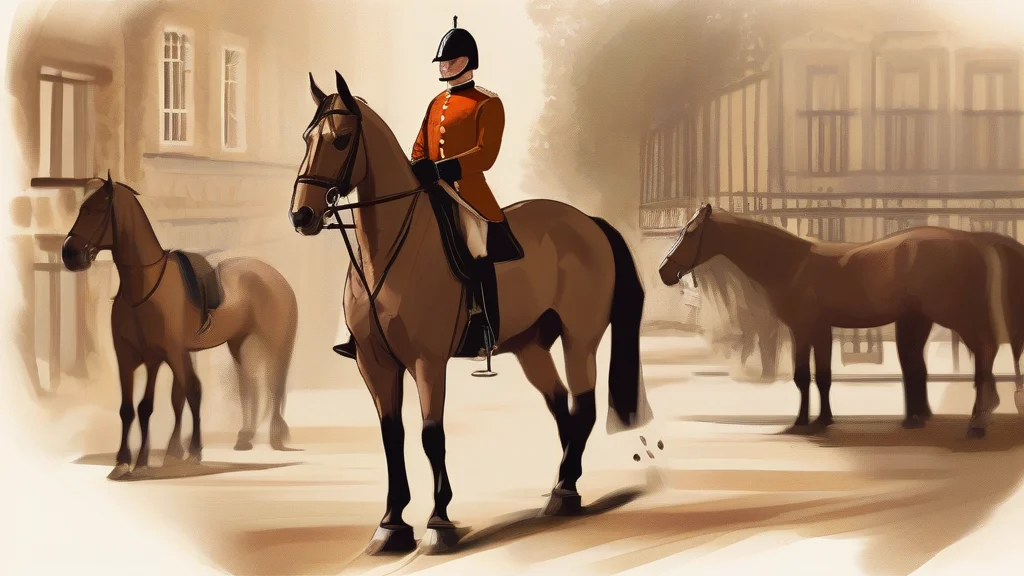
An equerry is a personal officer attached to a royal household, charged historically with overseeing the horses and stables and, in modern usage, serving as an aide and constant companion to a sovereign or other member of a royal family. In the British monarchy, equerries are usually serving officers drawn from the Army, Navy, or Air Force, seconded for a term of duty to accompany their principal at ceremonies, engagements, and official travels. The word derives from the French écurie, meaning stable, reflecting its equestrian origins, and is thus etymologically kin to squire and esquire. Though rare outside courtly and historical writing, it remains current in coverage of royal affairs and lends any text a note of formality and pageantry.
nounAn officer of a royal or princely household, typically responsible for the horses and stables, and often serving as a personal attendant to a member of the royal family.
- A personal officer of a member of a royal household, especially one attending on the sovereign or another royal personage on ceremonial and public occasions.
- (Historically) An officer in charge of the horses and stables of a royal household.
"The Queen's equerry accompanied her at every ceremonial engagement, standing discreetly at her side."
"As senior equerry to the King, Major Hughes coordinated the logistics of every royal procession."
"The young captain was appointed equerry to the Princess, accompanying her on tours abroad."
Standard plural; the y changes to -ies as with most nouns ending in a consonant + y.
"The palace announced that two new equerries had joined the household staff."
Every British monarch has been shadowed by an equerry — a military officer whose original job was mucking about with horses in the royal stables, yet who today stands just feet away during coronations and state funerals.
Reviewed by Deb Chak, Editor. AI-assisted content curated by RJS Tech Solutions LLP.
Etymology of equerry
Equerry entered English in the late sixteenth or early seventeenth century from the French équerry, derived from écurie, meaning 'stable', which itself traces back through older French forms ultimately connected to Germanic roots shared with words such as esquire and squire. Its earliest English sense concerned the officer responsible for the horses of a great household, and over time it broadened to denote a personal attendant on a royal personage. The word's cousinship with 'squire' reflects a common medieval heritage of service within a noble establishment.
How equerry is actually used
The word carries a distinctly formal, aristocratic register and appears almost exclusively in contexts concerning European royalty, particularly the British monarchy. Equerries are typically serving military officers seconded to the royal household. The plural is 'equerries'.
Easily confused with equerry
A 'query' is a question or inquiry, while an 'equerry' is an officer in a royal household — they rhyme but share no meaning.
An 'esquire' is historically a young nobleman attending a knight (now a courtesy title), whereas an 'equerry' specifically serves royalty and originally managed horses.