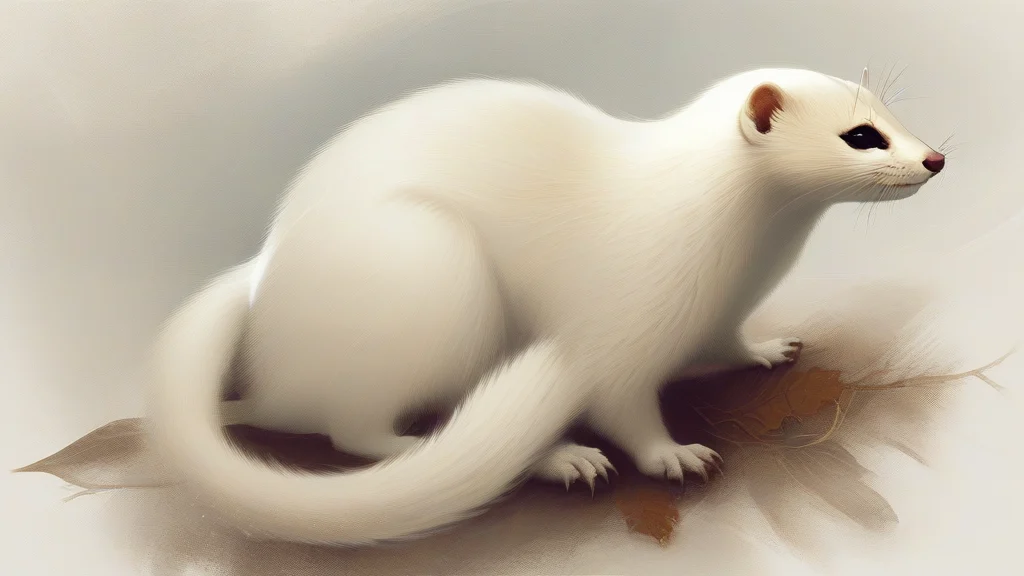
What does ermine mean?
Ermine refers primarily to the stoat, a small carnivorous mammal of the weasel family, particularly when it wears its distinctive white winter coat. By extension, the word denotes the animal's white fur, prized for centuries as a luxurious trim for the ceremonial robes of monarchs, peers, and senior judges, especially in Britain. In heraldry, ermine describes a pattern of white scattered with black tail-shaped spots, one of the classic furs of armorial design. Because of its long association with royalty and high office, the word carries connotations of dignity, purity, and aristocratic privilege — phrases like 'clothed in ermine' evoke the pomp of coronations and state openings of Parliament. The stoat itself was also a medieval symbol of moral purity, reputed to defend its snowy coat at any cost. Today ermine survives mainly in historical, ceremonial, and heraldic contexts rather than everyday speech.
A stoat, especially one in its white winter coat.
"An ermine darted across the snowfield, its coat indistinguishable from the drifts."
The white fur of the stoat, used to trim ceremonial robes.
"The chancellor processed into the chamber wrapped in ermine."
In heraldry, a white field strewn with black spots representing the stoat's tails.
"The family arms bore a bend ermine on a shield of gules."
The plural 'ermines' typically refers to multiple animals. When referring to the fur as a material, ermine is usually treated as uncountable ('trimmed with ermine').
"In winter, the fields were alive with ermines hunting for voles beneath the snow."
For centuries, ermine was so associated with royalty that wearing it without the right to do so could be a crime.
Reviewed by Deb Chak, Editor. AI-assisted content curated by RJS Tech Solutions LLP.
Etymology of ermine
Ermine entered English from Old French 'hermine' or 'ermine', which was likely borrowed from Germanic sources related to words for the animal found in languages such as Lithuanian and Old Church Slavonic. The word has been used in English since Middle English times, originally denoting the animal itself before extending to its fur and the heraldic pattern. Related forms appear across European languages, reflecting the animal's wide northern range and the fur trade that carried its name westward.
How ermine is actually used
The word carries strong connotations of aristocracy, ceremony, and judicial authority. It appears most often in historical or formal contexts; in everyday speech it is rarely needed except in discussion of heraldry or ceremonial dress.
Easily confused with ermine
An ermine moth is a small white moth whose larvae form webbed nests on trees — unrelated to the stoat or its fur.