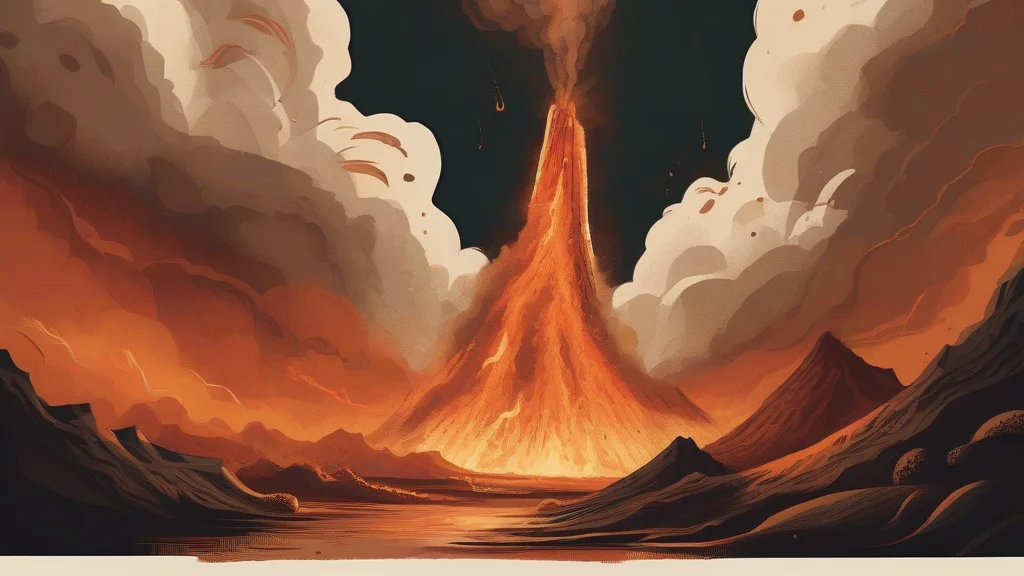
What does erupting mean?
Erupting is the present participle of the verb 'erupt', describing something that bursts forth or breaks out suddenly and with force. Its most familiar use is geological: a volcano erupting sends lava, ash, and gases violently to the surface, while geysers erupt in columns of boiling water. The word extends naturally to human affairs — violence, protests, or war may be described as erupting when they flare up without warning, and a crowd may be said to be erupting in cheers, laughter, or outrage. Medicine uses it of skin conditions breaking out in rashes, and dentistry of teeth emerging through the gums. Across all these senses, the common thread is abrupt, uncontrollable release from within. Derived from the Latin 'erumpere', meaning 'to break out', the word shares its root with 'rupture' and 'disrupt'. Vivid and dramatic, 'erupting' is invaluable whenever a writer wants to convey sudden, explosive change.
verb (present participle and gerund of 'erupt')The present participle of 'erupt': to burst out suddenly and violently, as lava from a volcano, or to break out abruptly, as war, laughter, or a rash.
- (of a volcano, geyser, etc.) to burst forth suddenly and violently with lava, ash, steam, or other material
- (of violence, war, disease, or unrest) to break out suddenly and forcefully
- (of a person or crowd) to express an emotion such as laughter, anger, or cheers in sudden, unrestrained outbursts
- (of a skin condition) to break out in spots, sores, or a rash
- (of a tooth) to emerge through the gum
"Tourists watched the geyser erupting in a towering plume of steam."
"Villagers fled as the volcano began erupting for the first time in decades."
"The courtroom gallery was still erupting with applause when the judge called for order."
When a volcano starts erupting, scientists call it 'going into eruption' — and the word itself literally means 'breaking out' in Latin, the same root that gives us 'rupture' and 'disrupt'.
Reviewed by Deb Chak, Editor. AI-assisted content curated by RJS Tech Solutions LLP.
Etymology of erupting
Erupting derives from the Latin verb 'erumpere', formed from 'e-' ('out') plus 'rumpere' ('to break'), meaning 'to break out or burst forth'. The English verb 'erupt' entered the language around the mid-17th century, initially in medical and general senses before becoming strongly associated with volcanoes as volcanology developed. The same Latin root 'rumpere' underlies cognates such as 'rupture', 'disrupt', 'interrupt', and 'corrupt'.
Related word forms
How erupting is actually used
Register is neutral — 'erupting' appears equally in scientific writing (geology, medicine, dentistry) and everyday journalism. It carries a connotation of suddenness and force; calmer processes would not normally be described this way. In figurative use it most often attaches to emotions, conflict, and crowds rather than individuals acting deliberately.
Easily confused with erupting
'Irrupting' means rushing in forcibly (often of populations or animals entering an area), while 'erupting' means bursting out or breaking forth from within.