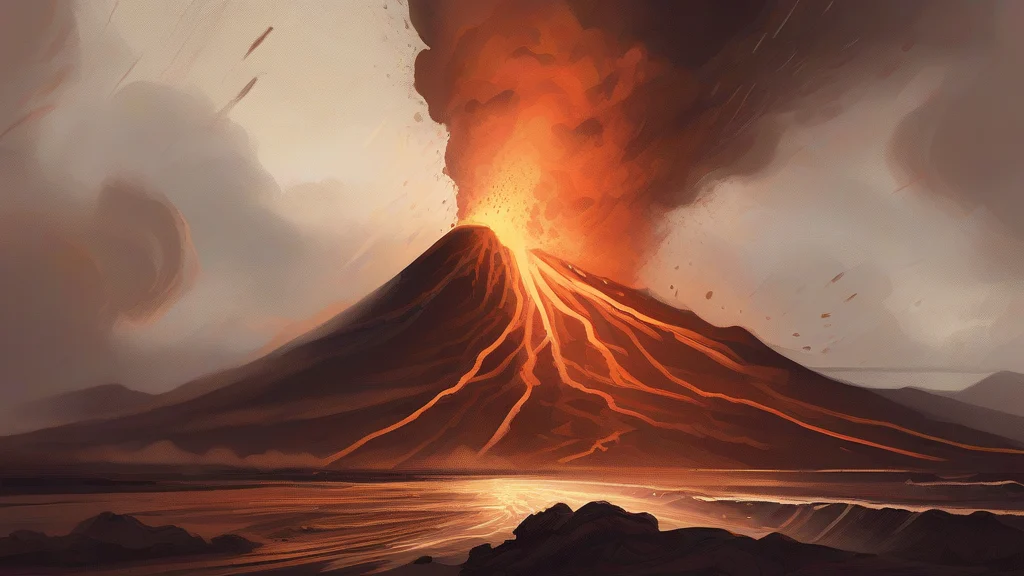
What does eruption mean?
An eruption is a sudden, violent bursting forth from within. Its most familiar sense is geological: the explosive release of lava, ash, and gases from a volcano, as in the historic eruptions of Krakatoa or Mount St. Helens. The word extends naturally to any abrupt outburst of something that had been contained — an eruption of violence, of cheering crowds, or of disease spreading through a population. In medicine, it also names a rash or breakout on the skin. Derived from the Latin eruptio, meaning "a breaking out," the word shares its root with rupture, interrupt, and disrupt. Eruption consistently implies force and pent-up pressure finally released, which gives it a dramatic register even in ordinary use. Whether describing molten rock, civic unrest, or childhood measles, the term conveys the image of something powerful surging past whatever boundaries once held it in check.
nounThe act or process of bursting out suddenly and violently, especially the ejection of lava, ash, and gases from a volcano. More broadly, a sudden outbreak of something previously held in or suppressed, such as violence, disease, or emotion.
- The sudden ejection of lava, ash, and gases from a volcano.
- A sudden outbreak or burst of something suppressed — violence, laughter, protest, or disease.
- The appearance of a rash or spots breaking out on the skin (medical usage).
"The eruption of Mount Vesuvius in 79 AD buried the Roman city of Pompeii under meters of ash."
"Scientists monitor seismic activity closely in hopes of predicting the next eruption."
"Her speech was interrupted by an eruption of applause from the audience."
Regular plural, standard in all varieties of English.
"The island's eruptions over the past century have reshaped its coastline several times."
When Vesuvius erupted in 79 AD, it released thermal energy hundreds of thousands of times greater than the Hiroshima bomb — and the word we use for it comes from the Latin for simply 'breaking out'.
Reviewed by Deb Chak, Editor. AI-assisted content curated by RJS Tech Solutions LLP.
Etymology of eruption
"Eruption" derives from the Latin eruptio, meaning "a breaking out" or "bursting forth," formed from erumpere — ex- ("out") plus rumpere ("to break"). The word entered English via French or directly from Latin around the early 17th century, initially in medical contexts before broadening to volcanic and figurative senses. It shares the Latin root rumpere with words such as rupture, interrupt, disrupt, and corrupt.
Related word forms
How eruption is actually used
"Eruption" carries connotations of suddenness and force, whether literal (geological) or figurative (emotional, social). In medical contexts, "eruption" is a somewhat formal term for a rash or skin breakout. The figurative use often appears with abstract nouns: "an eruption of anger," "an eruption of civil unrest."
Easily confused with eruption
An irruption is a sudden intrusion or a rapid influx into an area (as when birds irrupt into new regions), while an eruption is a bursting out from within, most famously of lava.