What does escalator mean?
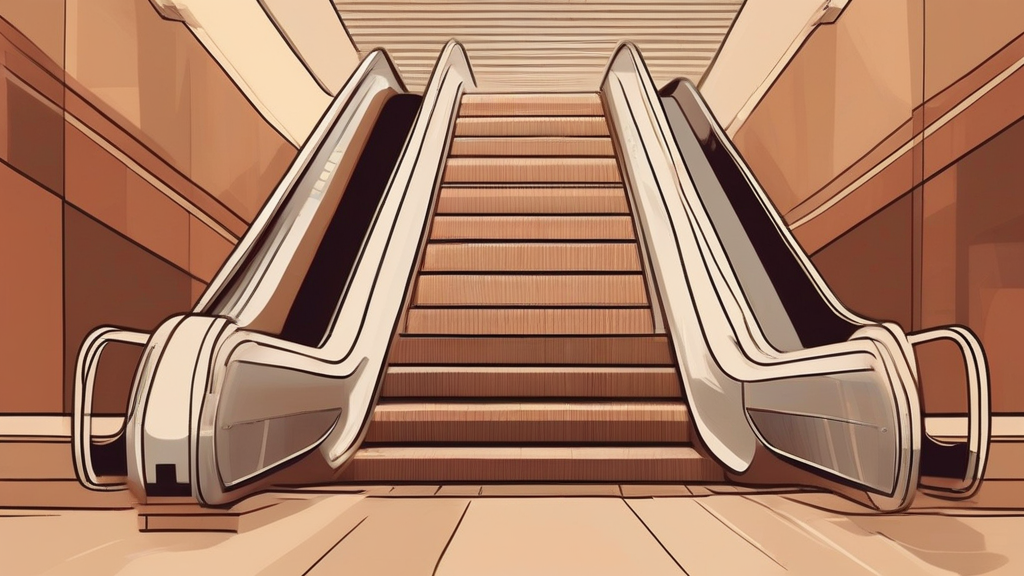
An escalator is a mechanical staircase whose steps form a continuous circulating loop, powered by an electric motor, that transports people between the floors of a building without their having to climb. Passengers simply step onto a moving step at the base and step off at the top, guided by a moving handrail running alongside. Escalators are fixtures of department stores, railway stations, airports, and metro systems, valued for their ability to move large numbers of people continuously in both directions. The word originated as a trademark coined by the Otis Elevator Company in the late nineteenth century, drawing on the Latin root scala, meaning ladder or stairs; through widespread generic use it lost its protected status and entered ordinary English, even giving rise to the verb 'to escalate'. Beyond its literal sense, 'escalator' survives in the fixed phrase 'escalator clause', denoting a contractual provision that allows wages or prices to rise automatically with the cost of living.
A power-driven staircase consisting of a continuously circulating chain of steps, used for carrying people up or down between levels of a building.
"She rode the escalator to the second floor while reading the directory."
Standard in both British and American English; often paired with verbs 'ride' or 'take'.
In finance and labor relations, short for 'escalator clause': a provision in a contract that allows prices, wages, or rents to increase automatically under stated conditions.
"The new agreement includes an escalator pegged to inflation."
Regular English plural; used when referring to multiple units or escalators generally.
"Both escalators were out of service, so shoppers took the lift instead."
'Escalator' was originally a trademark coined by the Otis Elevator Company — and like 'aspirin' and 'thermos', it became so widely used that the company lost its exclusive legal rights to the word.
Reviewed by Deb Chak, Editor. AI-assisted content curated by RJS Tech Solutions LLP.
Etymology of escalator
The word 'escalator' was coined in the 1890s by Charles Seeberger, working with the Otis Elevator Company, as a trademark name for their moving-staircase invention. It combines the Latin scala, meaning 'ladder' or 'flight of steps' (the same root behind 'scale' as in climbing), with the suffix '-ator' found in agent nouns like 'elevator'. Like other once-protected trademarks such as 'aspirin' and 'thermos', it fell into such common use that it became a generic term in English. The verb 'escalate', now most often used figuratively for rising conflict or costs, developed from this noun.
Related word forms
How escalator is actually used
Strictly speaking, one rides *on* an escalator rather than *in* it, though both prepositions appear in everyday use. In British English, 'escalator' is standard alongside 'lift' for the vertical conveyance; the word carries no strong register and appears equally in formal signage and casual speech. The financial sense ('escalator clause') is more common in American business and labor contexts than in everyday conversation.
Easily confused with escalator
An elevator (or lift) is a enclosed car that moves vertically on cables, whereas an escalator is an open moving staircase whose steps continuously circulate.
Escalation refers to a rapid increase or intensification of something such as conflict or costs, while an escalator is a physical moving staircase.