What does escutcheon mean?
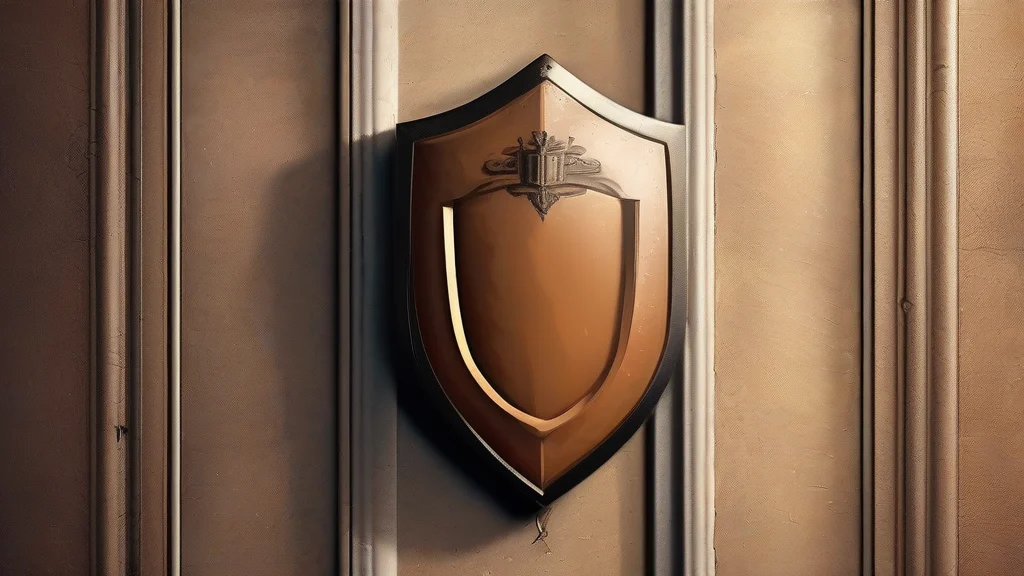
An escutcheon is, at its core, a shield — specifically the shield-shaped surface on which a coat of arms is displayed in heraldry. The word derives from the Latin scutum, meaning shield, and entered English via Old French in the medieval period when armorial bearings first became formalized. Beyond heraldry, the term extends to everyday objects: an escutcheon is also the decorative or protective metal plate that surrounds a keyhole, door handle, or light switch, particularly on fine furniture and architectural hardware. Figuratively, the word lives on in the expression 'a blot on one's escutcheon', meaning a stain on an otherwise honourable reputation — a phrase that preserves the shield as a symbol of personal integrity. Today, 'escutcheon' appears mostly in formal, historical, antiquarian, and genealogical writing, though collectors and restorers of antique furniture use it routinely for the brass plates fitted around locks and handles. It lends writing a tone of dignity and heritage wherever it appears.
nounA shield or shield-shaped surface bearing a coat of arms; by extension, any protective plate around a keyhole, switch, or other fitting, especially on a door or piece of furniture.
- A shield or shield-shaped surface displaying a coat of arms (heraldry).
- A protective or ornamental metal plate surrounding a keyhole, door handle, light switch, or similar fixture.
- (Figurative) A person's reputation or record of honour — chiefly in phrases such as 'a blot on one's escutcheon'.
"The family's escutcheon, emblazoned with three lions, hung proudly above the fireplace."
"The escutcheon above the manor gate bore the arms of the founding family."
"A tarnished brass escutcheon framed the keyhole of the antique writing desk."
Standard regular plural; used for both heraldic shields and hardware plates.
"The cabinetmaker replaced both tarnished escutcheons with polished brass replicas."
In medieval times, a knight's 'escutcheon of pretence' was literally a smaller shield placed over the main one to claim another family's arms — heraldry's way of wearing your ambitions on your chest.
Reviewed by Deb Chak, Editor. AI-assisted content curated by RJS Tech Solutions LLP.
Etymology of escutcheon
'Escutcheon' traces back to the Latin 'scutum', meaning shield, which passed into Old French as 'escuchon' or 'escusson' before entering Middle English in the medieval period. It belongs to the same family of words as 'scutcheon', an older English variant of the same term, and is related etymologically to words built on the Latin root for shield or hide, such as 'scute' and 'scutellate' (having shield-shaped markings). Its earliest uses were firmly heraldic, tied to the display of coats of arms on shields.
How escutcheon is actually used
Mostly encountered in formal, historical, or heraldic contexts today. The figurative sense survives mainly in the fixed phrase 'a blot on one's escutcheon', meaning a stain on someone's reputation.
Easily confused with escutcheon
Despite the superficial visual similarity in spelling, 'skeleton' means the structural frame of a body and has no connection to heraldic shields or plates.