What does esophagus mean?
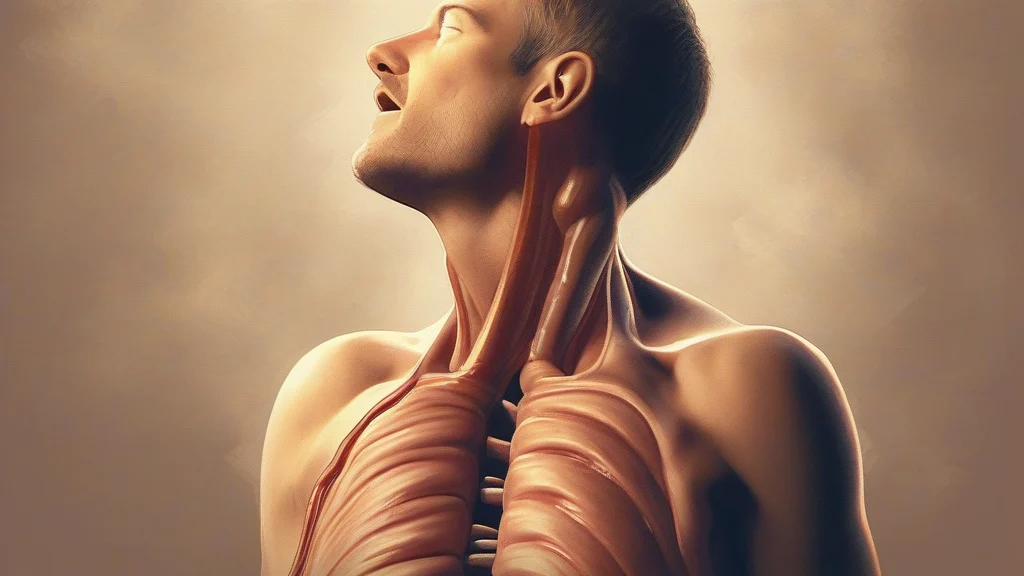
The esophagus is the muscular tube of the digestive system that connects the throat to the stomach, conveying swallowed food and liquid through coordinated wave-like contractions known as peristalsis. In adult humans it measures roughly twenty-five centimeters in length and lies behind the windpipe, passing through the diaphragm before opening into the stomach. The word is standard American spelling; British English uses "oesophagus." Though primarily an anatomical term found in medical and scientific writing, it also appears in everyday contexts such as discussions of heartburn, acid reflux, or swallowing disorders, since conditions like gastroesophageal reflux disease directly involve this organ. Its adjective form, "esophageal" (or "oesophageal"), is common in medical language, as in "esophageal sphincter." Understanding this term is useful because it names a structure central to one of the body's most basic functions — eating — and it recurs frequently in health reporting and clinical settings.
nounThe muscular tube that connects the throat (pharynx) to the stomach, through which swallowed food and liquid pass.
- The muscular tube running from the pharynx to the stomach along which food and drink are conveyed by peristaltic movement.
"A painful burn in her esophagus made it difficult to swallow anything but cool liquids."
"The endoscopy revealed mild inflammation in his lower esophagus."
"In humans, the esophagus is roughly twenty-five centimeters long."
The classical plural "esophagi" appears mainly in medical literature; "esophaguses" is also acceptable in general usage.
"The anatomy textbook compared the esophagi of several mammalian species."
Your esophagus doesn't just let food drop — muscles in its walls squeeze it down in wave-like contractions called peristalsis, which is why you could swallow upside down and your food would still reach your stomach.
Reviewed by Deb Chak, Editor. AI-assisted content curated by RJS Tech Solutions LLP.
Etymology of esophagus
The word comes from the ancient Greek "oisophagos," meaning "gullet" or "passage for food," a compound whose precise internal derivation remains debated among scholars. It entered English via late Latin and medieval medical Latin as "oesophagus," with the spelling attested from the early modern period; the American form "esophagus" reflects later simplification of the initial vowel cluster. The related adjective "esophageal" derives from the same root through the Latinized combining form.
Related word forms
How esophagus is actually used
"Esophagus" is the standard American spelling; "oesophagus" is preferred in British English. Both refer to the same anatomical structure, and the adjective forms follow suit (American "esophageal," British "oesophageal").
Easily confused with esophagus
The aorta is the body's largest artery carrying blood from the heart, whereas the esophagus is the muscular tube carrying food to the stomach.