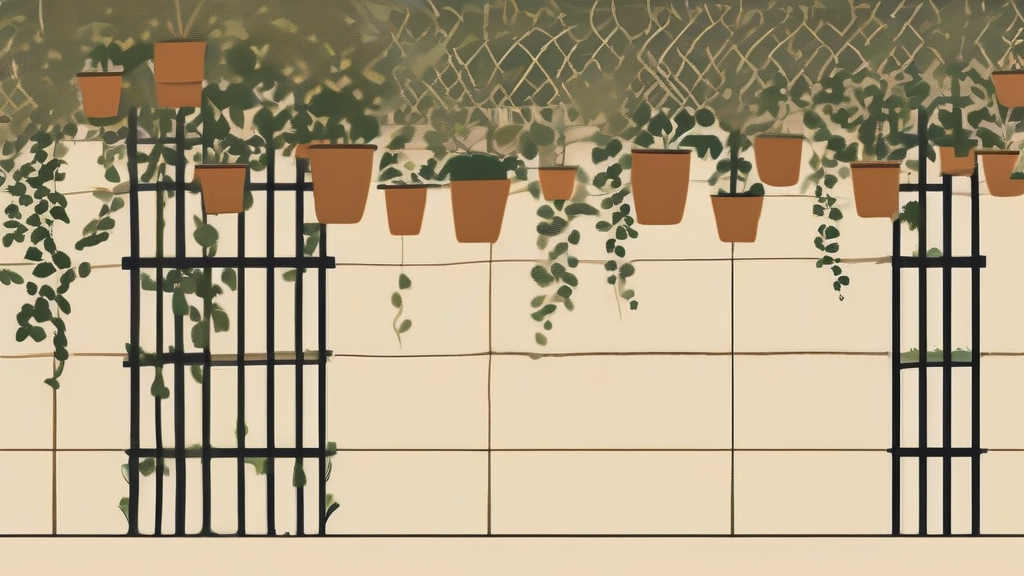
What does espalier mean?
Espalier refers to a tree or shrub that has been deliberately trained to grow flat against a wall, fence, or trellis, its branches typically arranged in formal, symmetrical tiers along horizontal wires or supports. The word also names the supporting framework itself and can function as a verb meaning to train a plant in this way. Espalier has long been prized in European gardening, particularly for fruit trees such as apples, pears, and figs: growing flush against a sun-warmed wall extends the ripening season, protects blossoms from frost, and makes harvesting easy, all while allowing productive trees to occupy remarkably little space. The technique demands patience and regular pruning, giving the word associations of craft, order, and horticultural elegance. Today espaliers appear not only in traditional kitchen gardens but in contemporary landscape design, where their sculptural silhouettes serve as living screens and ornamental focal points.
A tree or shrub trained to grow flat against a wall or on a trellis, usually with branches arranged in formal tiers.
"The walled garden featured an ancient espalier of pears still bearing fruit each autumn."
Also used for the trellis or framework on which such a plant is grown.
To train a tree or shrub to grow flat against a wall or trellis in a formal, flattened shape.
"He decided to espalier the apple tree along the south wall."
Standard English plural, used for multiple trained trees or frameworks.
"Rows of espaliers lined the greenhouse walls, heavy with ripening fruit."
That neat flat tree hugging an old brick wall isn't stunted — it's espalier, a French pruning art so efficient it lets fruit trees thrive in spaces barely wider than a garden path.
Reviewed by Deb Chak, Editor. AI-assisted content curated by RJS Tech Solutions LLP.
Etymology of espalier
Espalier comes from French espalier, which denoted both a shoulder strap and, by extension, a plant trained flat against a support. The French term derives from Italian spalliera, meaning a backrest or something set against the back, ultimately from spalla, 'shoulder', which traces back to Latin spatula via Late Latin spatha. The English word was adopted in the mid-17th century as the practice spread through formal European gardens. Cognates include the Italian spalliera itself and related Romance words built on the same 'shoulder/back' root.
How espalier is actually used
The word carries connotations of formal, disciplined gardening — it evokes walled kitchen gardens, orchards, and classical European design rather than casual landscaping. It is somewhat technical/horticultural in register but widely understood among gardeners. The plural 'espaliers' is standard for both the plants and their frameworks.
Easily confused with espalier
'Espial' means the act of watching or observation, while 'espalier' refers to a tree trained flat against a support or the act of training one.