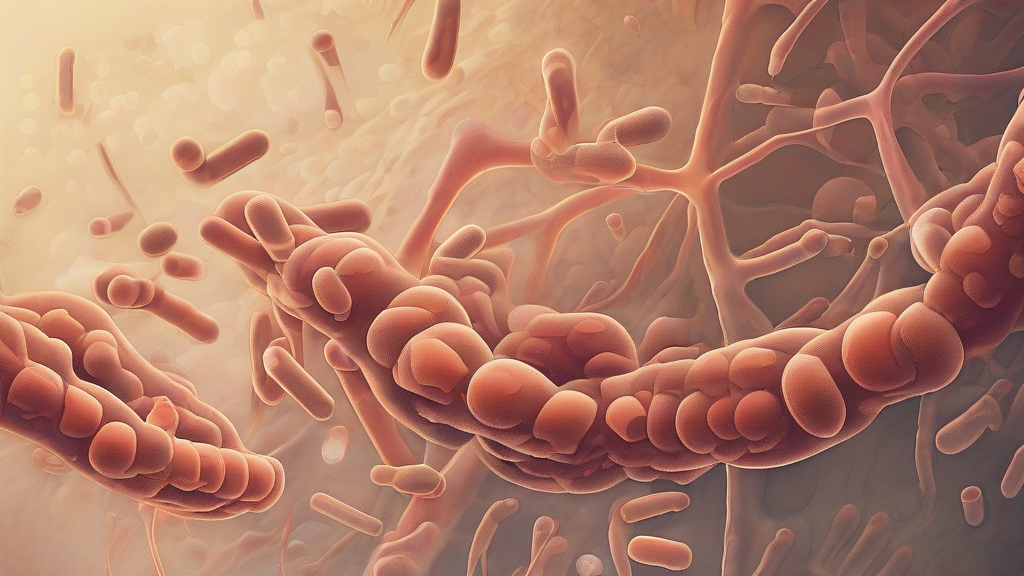
What does eubacteria mean?
Eubacteria are the so-called true bacteria: an enormous group of single-celled microorganisms whose cells lack a nucleus and other membrane-bound organelles. Alongside the archaea, they make up the two great lineages of prokaryotic life, but they differ from archaea in key biochemical respects — most notably in having cell walls built from peptidoglycan, a feature exploited by antibiotics such as penicillin. In older classification systems, notably the five-kingdom model, eubacteria were ranked as a full kingdom of life; in the newer three-domain framework they correspond to the domain Bacteria. The word is grammatically plural, with eubacterium as its singular, though it is commonly used as a collective term. Today it appears chiefly in biology textbooks, microbiology research, and discussions contrasting bacteria with archaea, since many modern writers simply use 'bacteria' where no such contrast is needed. Its etymology reflects its meaning: Greek eu- ('true' or 'good') combined with 'bacteria'.
nounEubacteria are the true bacteria: a large group of single-celled prokaryotic microorganisms that lack a nucleus and membrane-bound organelles, distinct from archaea. In older classification schemes they formed one of the major kingdoms or domains of life.
- The true bacteria considered collectively: single-celled prokaryotes with peptidoglycan cell walls, forming one of the two great prokaryote lineages alongside archaea.
- In former classification systems (notably the five-kingdom scheme), the kingdom comprising these organisms.
"Unlike archaea, eubacteria have cell walls containing peptidoglycan."
"Antibiotics such as penicillin work by targeting the peptidoglycan walls unique to eubacteria."
"Under the five-kingdom system, eubacteria were placed in their own kingdom apart from the more primitive archaebacteria."
The singular 'eubacterium' is rare outside technical microbiological writing; in most contexts 'eubacteria' functions as a collective plural or uncountable group noun.
"A single eubacterium can divide every twenty minutes under ideal conditions."
Every time scientists split life into domains, the humble eubacteria kept their crown as the 'true' bacteria — while their supposed cousins, the archaea, turned out to be an entirely different branch of life.
Reviewed by Deb Chak, Editor. AI-assisted content curated by RJS Tech Solutions LLP.
Etymology of eubacteria
The term combines the Greek prefix eu-, meaning 'true' or 'good', with 'bacteria', which derives ultimately from the Greek baktērion, diminutive of baktēria, referring to a small staff or rod — a nod to the rod-like shape of many early-studied bacteria. 'Eubacteria' was coined in the twentieth century to distinguish these true bacteria from the newly recognized archaebacteria (now archaea). Related English words sharing the bacterial root include bacterium, bacterial, bacteriology, and antibacterial.
Related word forms
How eubacteria is actually used
Strictly a plural form (singular: eubacterium), though it is frequently treated as a mass noun when referring to the group as a whole. The capitalized form Eubacteria denotes the formal taxon (domain or kingdom). In modern taxonomy influenced by three-domain systematics, many biologists simply say 'bacteria' rather than 'eubacteria', reserving the latter for contexts that contrast with archaea or with older classification schemes.
Easily confused with eubacteria
Archaea are a separate domain of prokaryotes that lack peptidoglycan cell walls and often live in extreme environments, whereas eubacteria are the 'true' bacteria with peptidoglycan walls.
Archaebacteria is an older term for what are now called archaea, formerly grouped with eubacteria under 'bacteria' but now recognized as a distinct domain.