What does euglena mean?
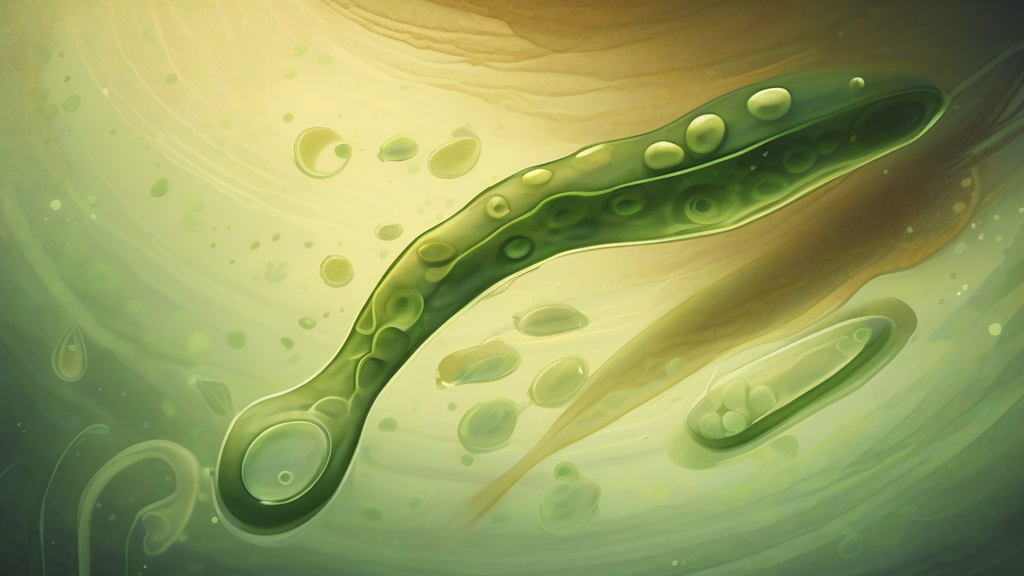
A euglena is a remarkable single-celled microorganism belonging to the genus Euglena, found chiefly in still freshwater such as ponds and ditches. It possesses features that once made it difficult for biologists to classify: like an animal, it moves actively by lashing a whip-like flagellum and can sense light through a reddish eyespot; like a plant, it contains chloroplasts and manufactures its own food through photosynthesis. This dual nature has made euglena a classic teaching specimen in introductory biology, illustrating how life resists tidy categories. The most studied species, Euglena gracilis, is widely used in laboratory research on photosynthesis, motility, and even biotechnology. In everyday English the word remains largely scientific rather than colloquial, appearing in educational writing and microscopy contexts. For anyone encountering it, "euglena" evokes the microscopic world's ingenuity — a tiny organism that quietly bridges two entire kingdoms of life.
nounA euglena is a single-celled freshwater microorganism of the genus Euglena, characterized by an elongated body, a whiplike flagellum used for movement, and chloroplasts that allow it to produce its own food through photosynthesis.
- Any single-celled, flagellated freshwater protist of the genus Euglena, capable of photosynthesis via its chloroplasts while also able to feed on organic matter.
- The genus Euglena itself as a taxonomic group within the phylum Euglenozoa.
"Under the microscope, the pond water teemed with euglena, their emerald bodies twisting and darting toward the light."
"The students observed a living euglena glide across the slide by whipping its single flagellum."
"Because euglena can survive without light by absorbing nutrients, it blurs the traditional line between plant and animal kingdoms."
"Euglena" is commonly left unchanged when used as a mass noun referring to organisms collectively; "euglenas" is the standard plural when counting individuals. In formal taxonomy, the genus name "Euglena" is capitalized and italicized.
"Several euglenas were visible swimming near the edge of the culture dish."
The euglena is both plant and animal at once — it swims like an animal but makes its own food from sunlight like a plant, which is exactly why it baffled early biologists.
Reviewed by Deb Chak, Editor. AI-assisted content curated by RJS Tech Solutions LLP.
Etymology of euglena
The word "euglena" derives from New Latin Euglena, the scientific genus name coined in the nineteenth century from Greek elements: "eu-" meaning good or true, and "glene" meaning eyeball or pupil, a reference to the organism's distinctive light-sensitive eyespot. This same Greek prefix "eu-" appears in many other English words borrowed ultimately from Greek, including "eugenic," "eulogy," "euphoria," and "eukaryote." The term entered English primarily through scientific literature describing newly catalogued microorganisms under the microscope.
How euglena is actually used
Scientific register: "euglena" appears mainly in biology textbooks, laboratory contexts, and popular science writing. As a genus name, "Euglena" is capitalized and italicized in formal taxonomy; lowercase "euglena" is used for individual organisms or informal reference. Plural usage varies — "euglena" may be treated as uncountable when referring to organisms en masse, while "euglenas" serves as the countable plural.
Easily confused with euglena
Paramecium is a different single-celled organism that moves using cilia and lacks the chloroplasts that let euglena photosynthesize.