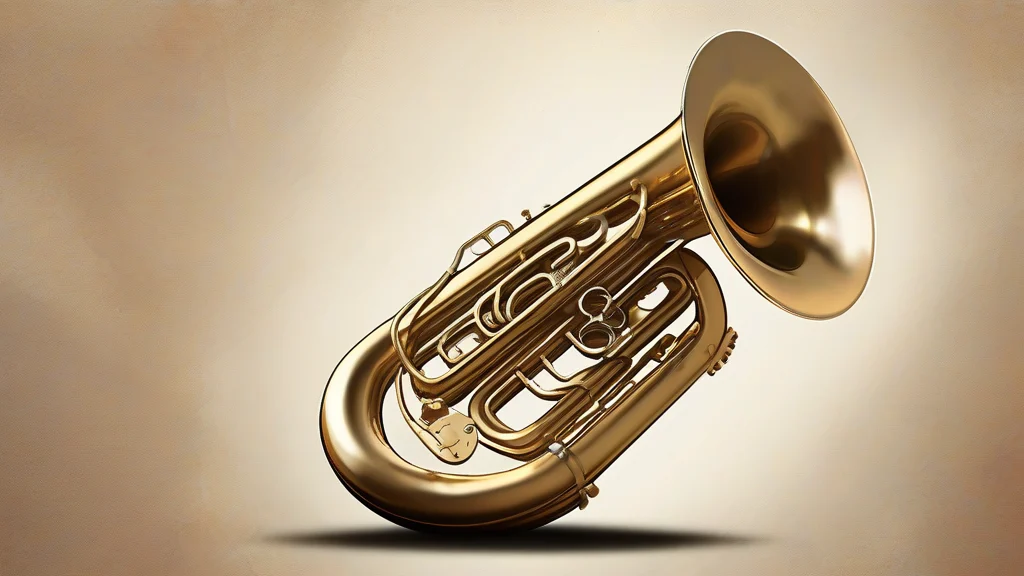
What does euphonium mean?
The euphonium is a valved brass instrument pitched in B-flat, sounding an octave above the tuba. It has a wide, conical bore that gives it a warm, mellow, and singing tone, which is why its name derives from the Greek words for 'good' and 'sound.' Developed in Germany during the 1840s, it quickly became the leading tenor voice of the brass band, especially in Britain, where it frequently takes lyrical solo passages. Players hold it upright like a small tuba, and its range overlaps comfortably with both the trombone and the cello, making it prized for smooth melodic lines. Although best known in military, brass, and concert bands, it also appears occasionally in orchestral works and solo repertoire. Because of its gentle timbre and expressive capability, the euphonium is sometimes described as the 'cello of the brass family,' and skilled performers are celebrated for the instrument's remarkable agility despite its size.
nounA large brass wind instrument with a conical bore and cup-shaped mouthpiece, pitched an octave above the tuba; it is the principal tenor voice of the brass band.
- A valved tenor brass instrument with a wide conical bore, pitched in B-flat an octave above the tuba, used chiefly in concert and brass bands.
"She switched from trombone to euphonium so she could play the soaring solo in the second movement."
"The euphonium carries the melody in most traditional British brass-band arrangements."
"He won a national competition for his euphonium performance at the conservatory recital."
'Euphoniums' is the standard plural; the Latin-style plural 'euphonia' is rare and mainly jocular or scholarly.
"The band's two euphoniums blended seamlessly with the trombones."
The euphonium was invented in Germany in the 1840s and named after a Greek word meaning 'pleasant-sounding' — and its rich, mellow tone lives up to the name.
Reviewed by Deb Chak, Editor. AI-assisted content curated by RJS Tech Solutions LLP.
Etymology of euphonium
The word 'euphonium' comes from the Greek 'eu' (well, good) combined with 'phōnē' (voice, sound), the same roots behind 'euphony,' 'euphemism,' and 'telephone.' The instrument itself was developed in Germany in the 1840s, with Sommer of Weimar credited with an early version around 1843, and its name reflects the pleasant tone it was designed to produce. English adopted the term directly from this German coinage in the mid-nineteenth century as the instrument spread through military bands.
Related word forms
How euphonium is actually used
A formal or technical musical term, familiar chiefly to musicians and band players; outside brass-band circles it is often confused with the baritone horn, which has a slightly different bore profile.
Easily confused with euphonium
The baritone is a closely related tenor brass instrument with a mostly cylindrical bore, giving it a brighter tone than the euphonium's warmer, more conical-bore sound.
Euphony refers to pleasing or harmonious sound in language or music generally, whereas the euphonium is a specific brass instrument.