What does evaporator mean?
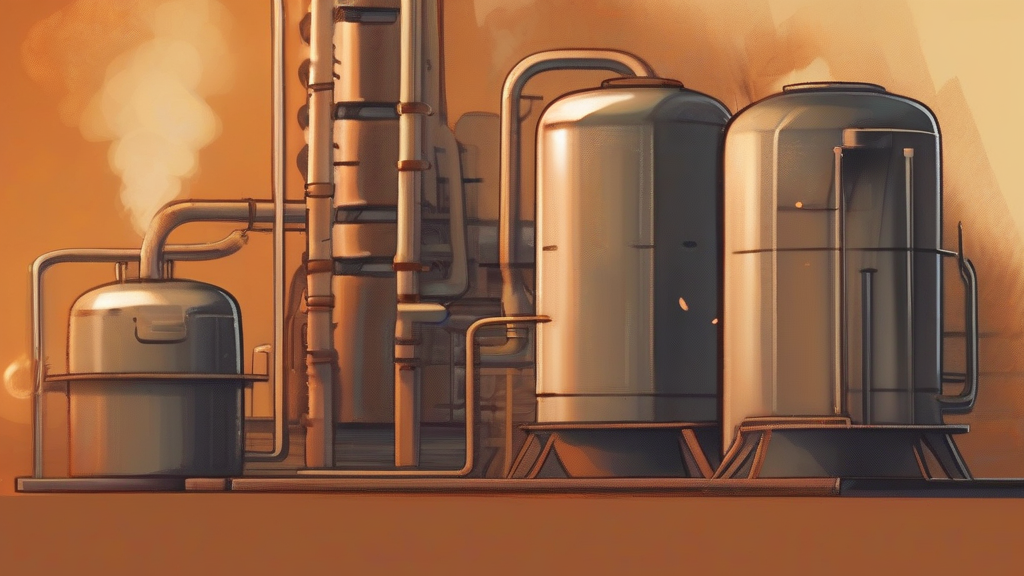
An evaporator is a piece of equipment designed to turn liquid into vapor. In industry, it applies heat to a solution—fruit juice, milk, brine, or chemical feedstock—to drive off water and leave behind a more concentrated product; rotary, falling-film, and vacuum evaporators are standard variants optimized for different materials and heat sensitivities. In refrigeration and air conditioning, the term takes on a related but distinct meaning: the evaporator is the coil where cold refrigerant absorbs heat from the surrounding air or food compartment, boiling off into vapor and thereby producing cooling. The word derives from the Latin evaporare, meaning 'to disperse in vapor,' via the verb 'evaporate.' Though largely confined to technical registers, the concept behind the word touches daily life everywhere—from the frost-free freezer to the production of salt, syrup, and dried foods.
A device that converts liquid into vapor, especially one that heats a solution to concentrate it by driving off water.
"The seawater passed through several stages of the evaporator before yielding crystallized salt."
Most frequent in industrial, chemical-engineering, and food-processing contexts.
In refrigeration systems, the component—typically a coiled tube—where refrigerant evaporates and absorbs heat, cooling the surrounding space.
"Technicians cleaned the dust from the evaporator to restore airflow through the air handler."
Standard terminology in HVAC and refrigeration engineering; contrasted with the condenser, which performs the opposite function.
Standard regular plural; commonly used when referring to multiple units, stages, or coil assemblies in a system.
"The refinery operates three evaporators in series to recover the solvent efficiently."
The same basic device that concentrates maple syrup in Vermont also chills your refrigerator and desalinates seawater — all by turning liquid into vapor on cue.
Reviewed by Deb Chak, Editor. AI-assisted content curated by RJS Tech Solutions LLP.
Etymology of evaporator
Evaporator comes from the Latin verb evaporare, formed from ex- ('out of') and vapor ('steam, vapor'), literally 'to give off in vapor.' English adopted the verb 'evaporate' around the early 17th century during a period of heavy borrowing from Latin scientific vocabulary, with the noun form for the device following later as the technology developed. It shares this Latin root with cognates such as 'evaporation,' 'evaporative,' and the broader family around 'vapor.'
Related word forms
How evaporator is actually used
Chiefly technical or scientific register; common in engineering, food processing, chemistry, and HVAC contexts rather than everyday speech. In refrigeration contexts it is often pluralized when referring to multiple units or coil assemblies.
Easily confused with evaporator
An evaporator turns liquid into vapor by adding heat, while a condenser does the reverse, turning vapor back into liquid by removing heat.