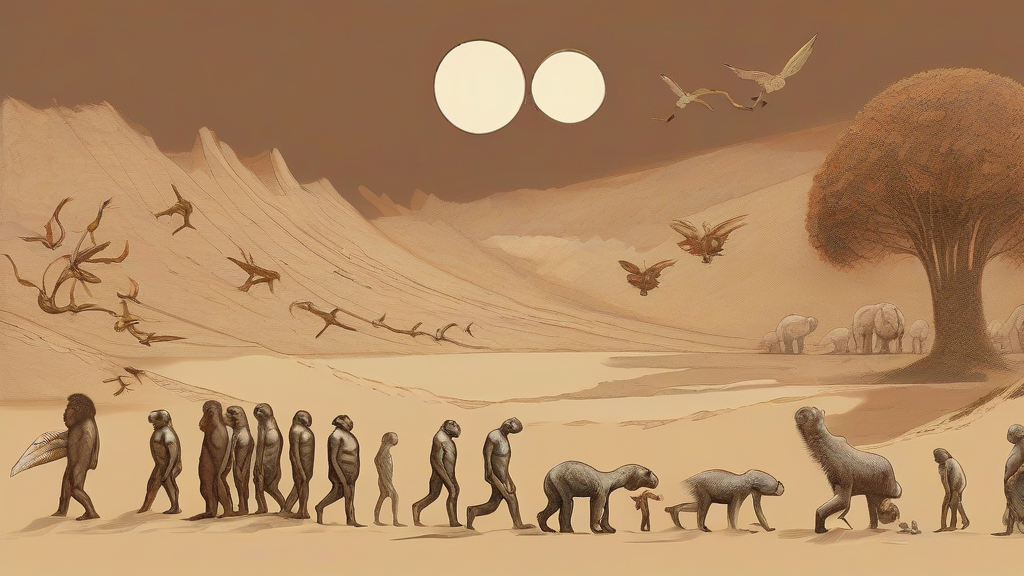
What does evolution mean?
Evolution is a noun describing gradual change and development over time. Its dominant sense is scientific: in biology, evolution is the process by which species of organisms change over successive generations, driven by variation and shaped by natural selection, giving rise to the diversity of life on Earth. Beyond biology, the word applies broadly to any slow, progressive transformation — the evolution of language, technology, political institutions, or personal beliefs. It derives from the Latin 'evolutio', meaning 'an unrolling,' originally evoking the image of a scroll being opened out; this sense of gradual unfolding still underlies all modern uses. Evolution is standard in both British and American English and appears most often in formal, academic, or journalistic registers, though it is entirely at home in ordinary speech. Importantly, in its biological sense it does not imply progress or improvement — only change — a distinction scientists often emphasize when explaining the term to the public.
nounThe gradual process by which living organisms change over successive generations through variation and natural selection. More broadly, the slow, progressive development of anything over time.
- In biology: the gradual development and diversification of living organisms across generations, driven by mechanisms such as natural selection.
- The gradual development or unfolding of something more general — an idea, culture, technology, or situation — over time.
- (Historical/rare) The act or process of unfolding, opening out, or unrolling.
"Darwin's theory of evolution transformed our understanding of the natural world."
"Scientists have traced the evolution of whales from land-dwelling ancestors."
"The evolution of the internet has reshaped nearly every aspect of modern life."
Rarely used in the plural; 'evolutions' appears mainly in older or military contexts (referring to manoeuvres or movements) and is uncommon in modern scientific writing, where the singular is standard even when discussing multiple processes.
"Military textbooks from the era describe complex battlefield evolutions in exhaustive detail."
The word 'evolution' comes from the Latin 'evolutio', meaning 'an unrolling' — as in unrolling an ancient scroll, life itself was imagined to unfold over time.
Reviewed by Deb Chak, Editor. AI-assisted content curated by RJS Tech Solutions LLP.
Etymology of evolution
Evolution derives from the Latin 'evolutio' ('an unrolling' or 'unfolding'), formed from 'evolvere' ('to roll out, unfold'), itself from 'e-' ('out') plus 'volvere' ('to roll'). The English word emerged in the early 17th century, initially carrying literal senses of unfolding or unrolling. Its biological meaning developed during the 19th century, becoming firmly associated with Darwin's theory following the 1859 publication of 'On the Origin of Species'. Cognates include French 'évolution' and German 'Evolution', all tracing back to the same Latin root.
Related word forms
How evolution is actually used
Primarily used in formal, academic, and scientific contexts, though its broader figurative sense ('the evolution of fashion') is common in everyday writing. In biology it carries no connotation of improvement or progress — merely change over generations — though in casual usage people sometimes wrongly assume it implies getting 'better.'
Easily confused with evolution
Not a real word — likely a typo for 'evolution' or 'revolution'; evolution refers to gradual development, while revolution refers to sudden or dramatic change.