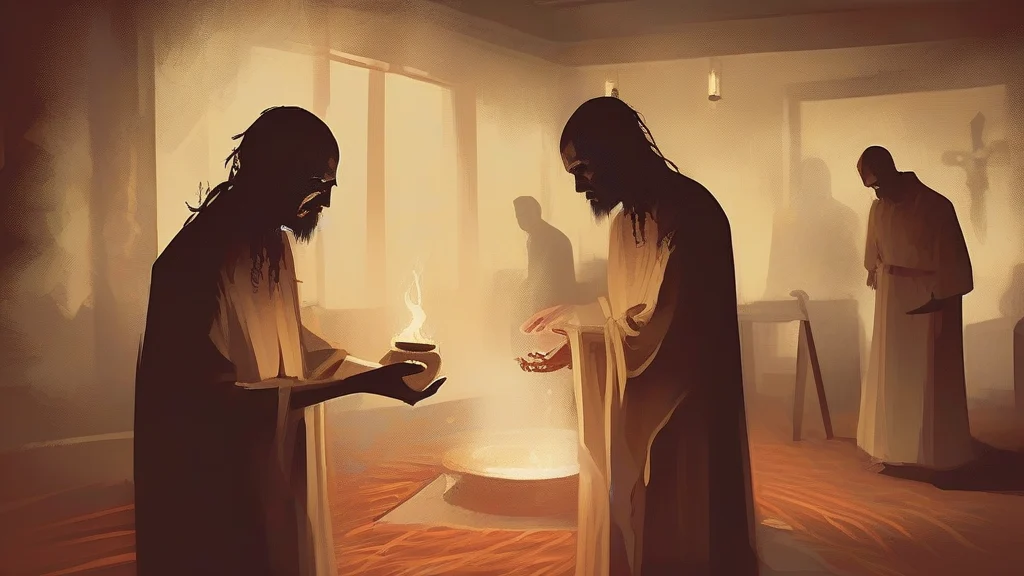
What does exorcism mean?
Exorcism is the act or ceremony of driving out an evil spirit or demon from a person, place, or object, usually by means of prayer, commands, or a formal religious ritual conducted by an authorized figure such as a priest. The word also extends figuratively to describe any forceful removal of something unwelcome, as in describing an election as an exorcism of past corruption. Rooted in ancient religious practice and attested in English since the early seventeenth century, exorcism carries solemn, dramatic connotations and appears most often in contexts involving religion, folklore, horror fiction, and film. While literal belief in demonic possession varies widely, the word remains culturally prominent, evoking rituals of cleansing and liberation. It functions almost exclusively as a noun, with related verb forms exorcize or exorcise describing the act itself.
The act or rite of expelling an evil spirit or demon from a person, place, or object, especially by prayer or formal religious ceremony.
"The village priest was called upon to perform an exorcism at the abandoned chapel."
In Roman Catholic practice, an exorcism requires authorization from a bishop and follows a prescribed rite.
Figuratively, the forcible removal or banishment of something regarded as oppressive or unwanted.
"The new management's restructuring was described as an exorcism of the company's old culture."
The plural is regular and commonly used when referring to multiple rites or instances, whether literal or figurative.
"Medieval church records contain accounts of numerous exorcisms performed across Europe."
The Catholic Church still maintains official exorcists today — every diocese is expected to have one on call.
Reviewed by Deb Chak, Editor. AI-assisted content curated by RJS Tech Solutions LLP.
Etymology of exorcism
Exorcism comes from the Late Latin exorcismus, borrowed from the Greek exorkismos meaning "an adjuration or oath-bound binding," derived from exorkizein, "to bind by an oath," formed from ex- ("out") plus horkos ("oath"). The underlying idea was compelling a spirit by invoking a higher authority. The term entered English in the early seventeenth century through ecclesiastical Latin usage. Cognates and derivatives include exorcist, the person who performs the rite, and the verbs exorcize and exorcise.
How exorcism is actually used
"Exorcism" carries strong religious and supernatural connotations and belongs chiefly to formal, literary, or journalistic registers when used literally; figurative uses are common in political and cultural commentary. The verb has two accepted spellings — "exorcize" (more American) and "exorcise" (more British) — but the noun is spelled identically everywhere.
Easily confused with exorcism
Exhaustion means extreme tiredness, whereas exorcism refers to the ritual expulsion of an evil spirit; they share only a similar opening sound.
Exercise is physical or mental activity for health or practice, while exorcism is a religious rite to expel demons; the words look somewhat alike but are unrelated.