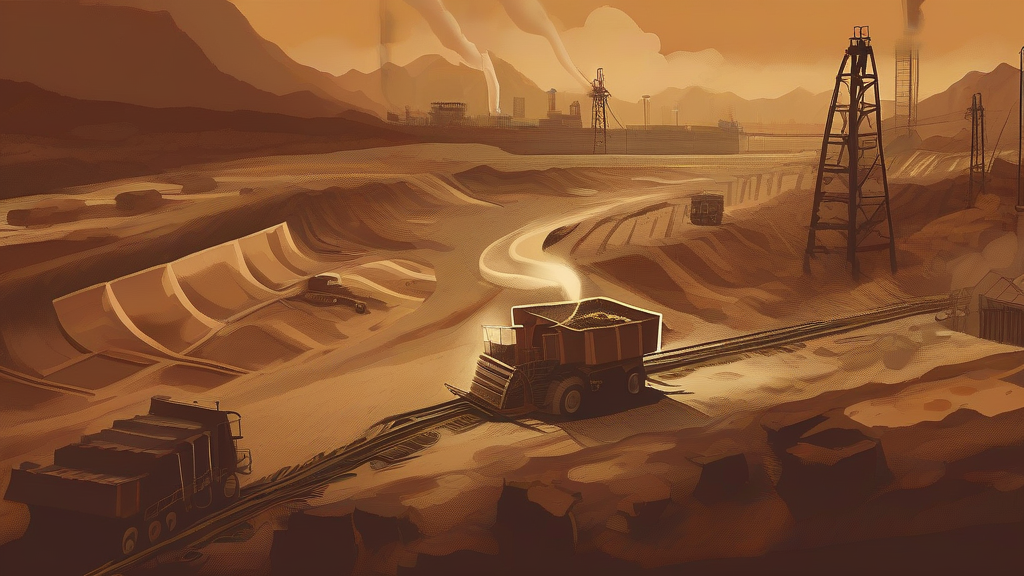
What does extractive mean?
"Extractive" is an adjective describing activities or systems centered on taking something out — most commonly natural resources such as minerals, oil, gas, timber, or fish drawn from the environment. An "extractive industry" is standard terminology for mining, drilling, and logging sectors, and an "extractive economy" is one that depends heavily on them. In political and economic writing, the word has acquired a broader, critical sense: extractive institutions are those that siphon wealth and power from the many toward the few, in contrast to inclusive or regenerative systems. The term derives ultimately from Latin "extrahere," meaning to draw out. Though neutral when used technically, as in chemistry's extractive processes, it usually carries connotations of depletion, exploitation, and short-term gain, making it a pointed word in debates about sustainability and development.
Relating to or involving the removal of natural resources from the earth, or, more broadly, tending to draw out wealth or value while giving little in return.
"Extractive industries have left deep environmental scars across the valley."
Most frequently used attributively before nouns such as "industry," "sector," or "economy."
A substance extracted or distilled from something; also, a passage quoted or taken from a text.
"The pharmacist prepared several vegetable extractives for the tincture."
The noun senses are relatively rare today; "extract" is far more common for both meanings.
As a plural noun, "extractives" refers chiefly to extracted chemical substances, especially in wood chemistry and pharmacology.
"Wood extractives give different timber species their distinctive colors and odors."
'Extractive' began as a chemistry term for drawing substances out of matter — now it's economists' favorite word for economies that take from the land without giving anything back.
Reviewed by Deb Chak, Editor. AI-assisted content curated by RJS Tech Solutions LLP.
Etymology of extractive
"Extractive" comes from Latin "extrahere," meaning "to draw out," formed from "ex-" (out) plus "trahere" (to pull or drag). The word entered English in the early modern period alongside related forms such as "extract" and "extraction." Its modern prominence owes much to nineteenth-century industrial vocabulary, when "extractive industries" became a fixed economic category, and to twentieth-century development economics, where "extractive" came to describe whole economies and institutions. It shares its Latin root with words such as "extricate" and "abstract."
Related word forms
How extractive is actually used
"Extractive" carries a strongly negative connotation in modern political and economic discourse, where "extractive institutions" or an "extractive mindset" implies exploitation and short-term thinking. In technical contexts such as chemistry or engineering, the word is neutral and simply describes extraction processes. It appears most often attributively, before a noun such as "industry," "sector," or "economy."
Easily confused with extractive
An extract is the thing removed (such as a vanilla extract), whereas extractive describes the process or tendency of removing it.