
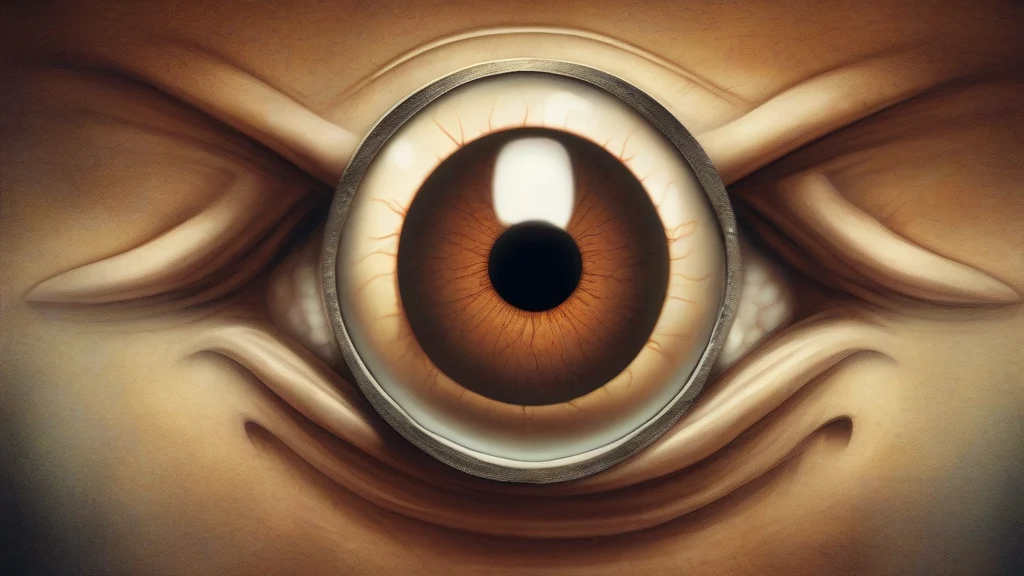
What does eyeball mean?
An eyeball is the roughly spherical organ of vision, protected within the bony socket of the skull and responsible for gathering light and converting it into the signals the brain interprets as images. In everyday English the word appears most often in medical, anatomical, or vividly descriptive contexts, since many speakers simply say 'eye' when referring to sight generally. Beyond its noun form, 'eyeball' also functions as an informal verb meaning to look at something closely or to make a rough visual estimate, as in 'I'll just eyeball the measurements.' The expression 'eyeball to eyeball' evokes a direct, high-stakes confrontation between two parties. The word's concreteness gives it force: it is the term surgeons, optometrists, and journalists reach for when precision or drama matters. Familiar yet anatomically specific, 'eyeball' is useful both as plain description of the body and as colourful shorthand for looking, judging, and facing off.
The round, ball-shaped organ of vision, situated in the orbit of the skull.
"A speck of dust had lodged on the surface of his eyeball."
Often preferred over 'eye' in clinical, anatomical, or deliberately vivid contexts.
(Informal) To look at closely or assess by visual estimation rather than precise measurement.
"He eyeballed the gap before deciding the sofa would fit through the door."
Informal register; conjugates as 'eyeballed', 'eyeballing'.
Standard plural; commonly used in medical writing and in phrases like 'eyeballs on screen' (informal media jargon for viewers).
"The optometrist examined both eyeballs under bright light."
Your eyeballs don't grow much after birth — which is why babies' eyes look so strikingly large in such small faces.
Reviewed by Deb Chak, Editor. AI-assisted content curated by RJS Tech Solutions LLP.
Etymology of eyeball
The compound 'eyeball' is formed transparently from 'eye', from Old English 'ēage', and 'ball', from Old Norse 'böllr'. It has been part of English since at least the early modern period, with Shakespeare famously using it in 'The Tempest' around 1610-1611 ('his eyeball in his head'). Its verbal use, meaning to inspect visually, arose much later, chiefly in twentieth-century American English slang.
How eyeball is actually used
As a noun, 'eyeball' is standard but slightly more clinical or graphic than simply 'eye'; it is common in medical and informal contexts alike. The verb 'to eyeball' is firmly informal and means to look at closely or judge by visual estimation rather than measurement. The phrase 'eyeball to eyeball' describes a tense face-to-face confrontation.
Easily confused with eyeball
'Eye' refers broadly to the organ of sight or the act of looking, while 'eyeball' specifically denotes the spherical structure of the eye itself.