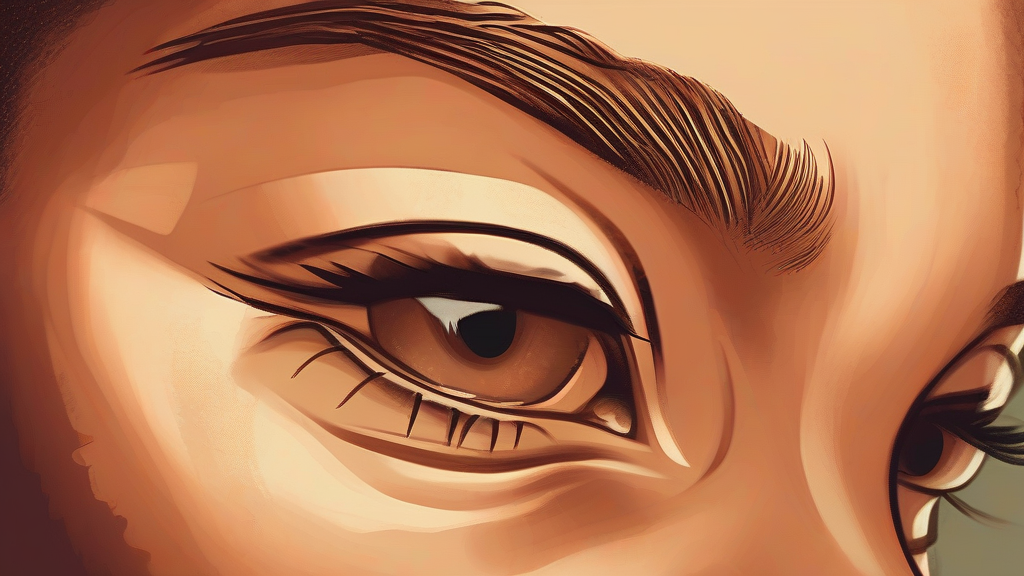
What does eyebrow mean?
An eyebrow is the strip of short hair growing along the bony ridge just above each eye. Eyebrows play both a practical and expressive role: they help keep sweat and debris out of the eyes, and they are among the most mobile features of the face, used to signal surprise, skepticism, disapproval, or interest. In everyday English the word appears most often in the plural, as in "she arched her eyebrows," while the singular is common in idiomatic expressions such as "he raised an eyebrow," meaning to react with mild doubt or astonishment. The related expression "to raise eyebrows" describes causing shock or disapproval among observers. Beyond its literal sense, the word carries strong connotations of nonverbal communication and social judgment. Cosmetically, eyebrows have long been shaped, plucked, penciled, and styled according to fashion, making the word familiar in beauty and grooming contexts as well as ordinary conversation.
nounThe strip of short hair growing on the bony ridge above each eye, or the ridge itself.
- The arch of short hairs growing on the ridge above each eye.
- The bony ridge itself above the eye (as in anatomy or descriptions of injury).
"She raised an eyebrow at his excuse, clearly unconvinced."
"He raised a skeptical eyebrow when I told him the fish had been that big."
"She arched her eyebrows in surprise at the news."
Standard regular plural; far more common than the singular in everyday usage.
"Her eyebrows shot up when she saw the bill."
Raising one eyebrow is a skill only about half of people can do — and it's the universal sign for skepticism in almost every culture.
Reviewed by Deb Chak, Editor. AI-assisted content curated by RJS Tech Solutions LLP.
Etymology of eyebrow
Eyebrow is a straightforward compound of two Old English words: ēage (eye) and brū (brow), combining in Middle English as ey-browe. The compound simply names the brow of hair situated above the eye, following the transparent pattern of other body-part compounds like eyelash and eyelid. It has direct parallels across Germanic languages, such as Dutch wenkbrauw and German Augenbraue, though these use different roots for the eye element.
How eyebrow is actually used
Almost always used in the plural when referring to a person's appearance; the singular is more common in figurative expressions like "raised an eyebrow." The verb phrase "to raise eyebrows" means to cause surprise or disapproval.
Easily confused with eyebrow
"Brow" can refer to the forehead or the eyebrow region generally, while "eyebrow" refers specifically to the strip of hair above the eye.