
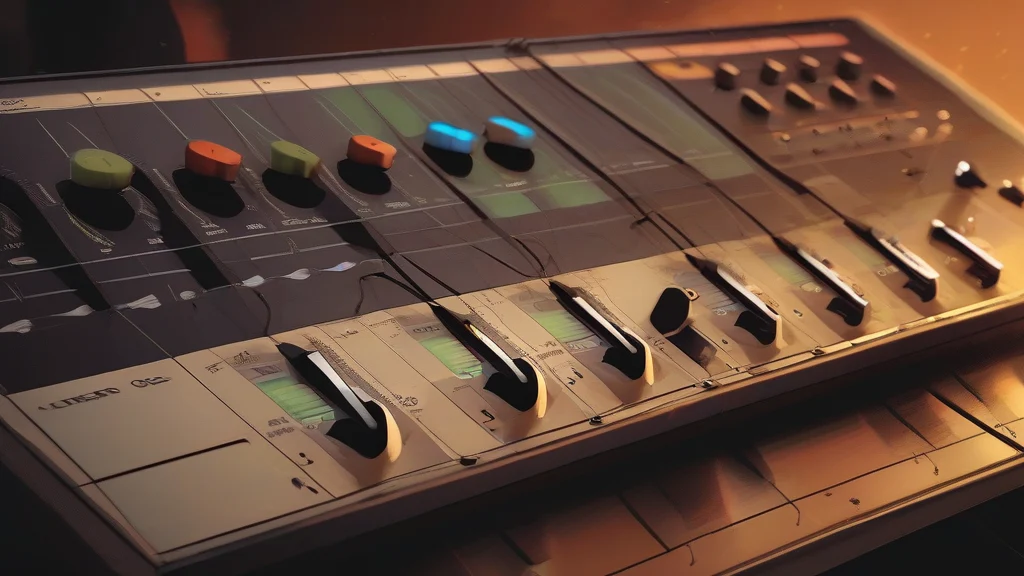
What does fader mean?
A fader is a sliding control—most familiar as a physical lever on a mixing console or a virtual slider in audio software—that adjusts the volume or intensity of an audio signal. Unlike a rotary knob, a fader moves along a track, allowing an engineer to make smooth, precise changes to a channel's level, which is why it is indispensable in recording studios, live-sound rigs, and DJ equipment. Common types include the master fader, which governs an entire mix, and the crossfader, which blends one signal into another. The word derives from the verb "fade," ultimately tracing back through Old French to a root connoting growing weak or weary—an apt ancestor for a device whose whole purpose is gradual diminishment. In historical texts, "fader" also appears as a now-obsolete spelling of "father," but modern readers encounter it almost solely in audio contexts.
nounA control on an audio mixing console or software interface that smoothly raises or lowers the level of a signal, typically a sliding lever. By extension, any mechanism or person that causes something to fade or diminish gradually.
- A sliding control on an audio mixing console, DJ mixer, or recording software used to adjust the volume or level of a signal.
- Archaic spelling of "father," found chiefly in Middle English texts such as early translations of the Lord's Prayer.
"The engineer eased the fader down as the song reached its final chord."
"She nudged the vocal fader up two decibels during the chorus."
"The medieval manuscript rendered the prayer's opening as "Oure fader that art in heven.""
Regular plural, standard in all varieties of English.
"The mixing desk has thirty-two channels, each with its own fader, but the two main faders sit at the far right."
Every time a DJ slides a crossfader between two tracks, they're using a word whose oldest ancestor meant simply 'to grow weak.'
Reviewed by Deb Chak, Editor. AI-assisted content curated by RJS Tech Solutions LLP.
Etymology of fader
The noun "fader" is formed from the verb "fade" plus the agentive suffix "-er," denoting an instrument or agent that performs the action. The verb "fade" entered English in the late Middle Ages from Old French "fader" (variant of "feidre"), meaning to grow weak, itself likely descended from a Vulgar Latin derivative of Latin "fatuus" (foolish, insipid) — the same root behind "fatuous" and "infatuation." The homographic Middle English "fader" meaning "father" comes from an entirely separate Germanic line, Old English "fæder," and has no connection to the audio sense beyond coincidence of spelling.
How fader is actually used
In contemporary English, "fader" is almost exclusively a technical term used by audio engineers, musicians, and DJs; its use as a form of "father" survives only in historical or literary contexts. The plural is regular ("faders").
Easily confused with fader
"Fader" is an obsolete Middle English spelling of "father" but in modern usage means an audio-level control, whereas "father" refers to a male parent.
A "feeder" supplies something (such as food or material), while a "fader" reduces or gradually diminishes a signal's strength.