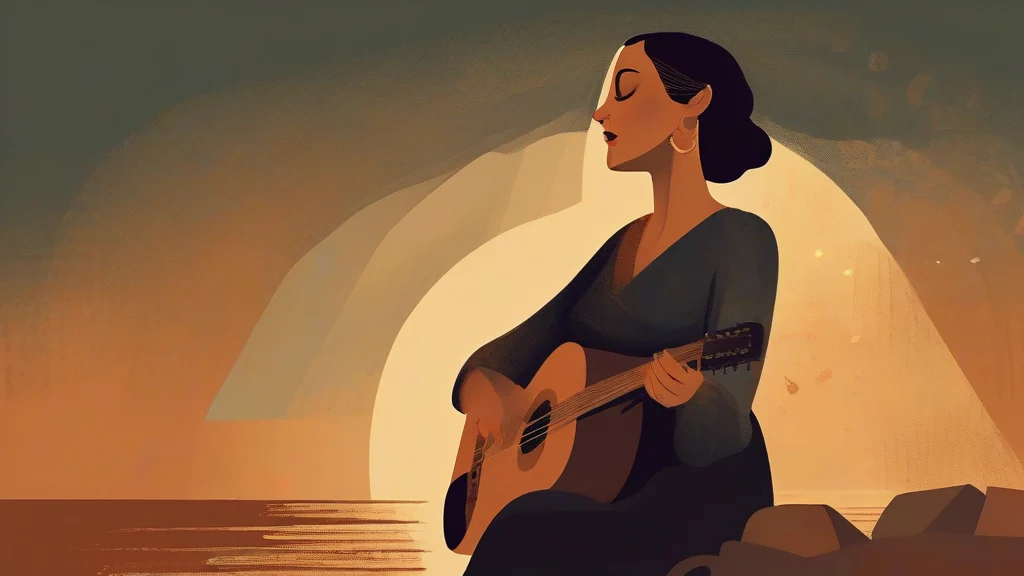
What does fado mean?
Fado is a form of Portuguese folk music renowned for its deep melancholy and expressive intensity. The word derives from the Latin 'fatum', meaning fate or destiny, reflecting the music's characteristic preoccupation with longing, loss, love, and the hardships of life at sea. Traditionally performed in Lisbon and Coimbra by a solo vocalist accompanied by the Portuguese guitarra — a distinctive pear-shaped twelve-string instrument — and a classical guitar, fado is closely associated with the concept of 'saudade', an untranslatable Portuguese sense of wistful yearning. The genre emerged in the early nineteenth century in Lisbon's working-class neighborhoods, notably Alfama and Mouraria, and was popularized internationally in the twentieth century above all by the legendary singer Amália Rodrigues. Both the music itself and an individual song in this tradition may be called a fado, and in 2011 UNESCO recognized it as part of the Intangible Cultural Heritage of Humanity.
nounA genre of Portuguese folk music characterized by mournful melodies and lyrics, typically about the sea or the hardships of life, traditionally accompanied by a twelve-string guitar and a Portuguese guitarra. A song performed in this style is also called a fado.
- A style of melancholic Portuguese folk music, typically featuring themes of longing, loss, and the sea, accompanied by the Portuguese guitarra and classical guitar.
- An individual song performed in this style.
"In the taverns of Lisbon's Alfama district, the fado drifted out into the narrow streets late into the night."
"Amália Rodrigues remains the most celebrated voice in the history of fado."
"The restaurant fell silent as the fado singer began her first mournful verse."
Rarely used; fado is usually uncountable when referring to the genre, and individual songs are more often referred to simply as 'songs'.
"The album collects traditional fados from across the Alfama quarter."
Fado literally comes from the Latin word for 'fate' — a whole musical genre named after destiny itself.
Reviewed by Deb Chak, Editor. AI-assisted content curated by RJS Tech Solutions LLP.
Etymology of fado
Fado entered English from Portuguese, where it means literally 'fate' or 'destiny'. The Portuguese term descends from the Latin 'fatum', meaning 'that which has been spoken', hence an oracle's pronouncement and ultimately fate — the same root that gives English words such as 'fate', 'fatal', and 'fatalism'. The name reflects the music's defining themes of destiny, sorrow, and longing. The word became established in English writing about music during the nineteenth century as European travelers described the songs they heard in Lisbon.
How fado is actually used
Usually treated as an uncountable noun when referring to the music genre generally ('a night of fado'), but countable when referring to individual songs ('a haunting fado'). Often italicized in older British texts; modern usage typically sets it in roman type. In 2011, UNESCO inscribed fado on its list of Intangible Cultural Heritage of Humanity.
Easily confused with fado
The Irish 'fadó' means 'long ago' and appears in the phrase 'fadó fadó' ('long, long ago') that opens Irish folktales — entirely unrelated to the Portuguese music genre.