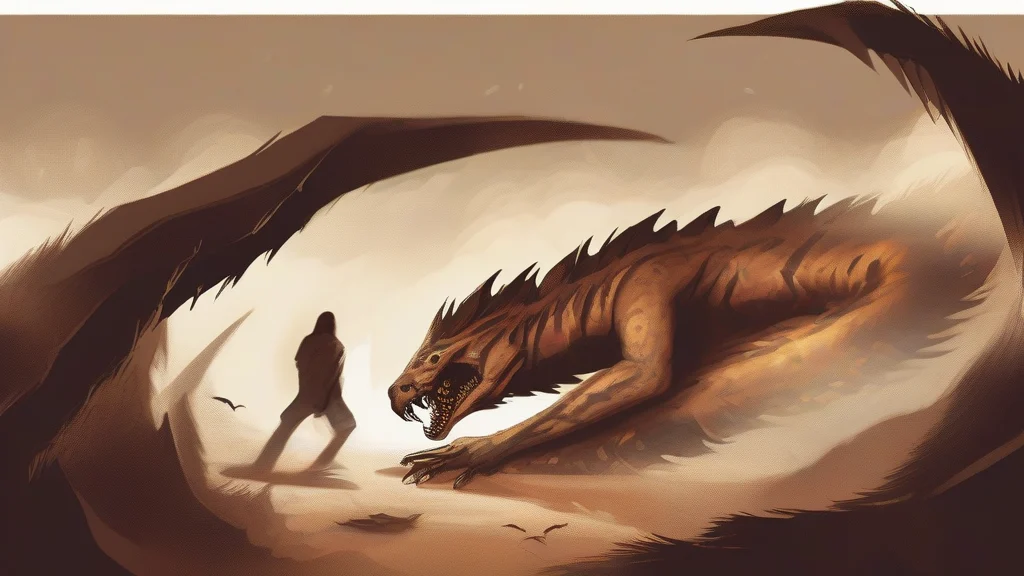
What does fanged mean?
'Fanged' describes something possessing fangs — the long, sharply pointed canine teeth characteristic of snakes, spiders, and many predatory mammals. In literal use it appears most naturally in descriptions of animals and creatures: a fanged viper, a fanged skull, a long-fanged cat. Because prominent fangs read instantly as threatening, the word has also developed a figurative life, lending menace to descriptions of aggressive prose, biting satire, or hostile rhetoric. Its connotations are therefore almost always dangerous or predatory rather than neutral. The word derives from 'fang', which traces back to Old English 'fang', originally meaning seizure or capture — the sense of grasping prey preceded the sense of the tooth that does the grasping, a history that explains why 'fang' and 'fanged' carry an inherent suggestion of attack. Writers reach for 'fanged' when they want an image of sharp-toothed danger, whether describing real wildlife or evoking ferocity metaphorically, making it a compact and vivid descriptive adjective.
adjective (also past participle of the verb 'fang')Having fangs, especially long, sharp, protruding canine teeth such as those of a snake, spider, or predatory animal. More broadly, used figuratively to describe something fierce, menacing, or aggressive in character.
- Equipped with fangs or long pointed canine teeth, as of a snake, spider, or beast of prey.
- Used figuratively to describe something menacing, aggressive, or predatory in tone or appearance.
"The viper lay coiled on the rock, its fanged mouth slightly open."
"The tarantula reared back, revealing its fanged jaws."
"The critic's fanged review left no reputations intact."
Before it meant a tooth, 'fang' meant a trap — the word comes from an Old English term for seizing prey or plunder.
Reviewed by Deb Chak, Editor. AI-assisted content curated by RJS Tech Solutions LLP.
Etymology of fanged
'Fanged' is the participial form of 'fang', which descends from Old English 'fang', meaning a seizure or booty, and the related verb 'fon', 'to seize'. The word belongs to a Germanic family — Old High German 'fang' and modern German 'fangen' ('to catch') share this root. During the Middle English period the meaning narrowed from 'that which seizes' to the seizing tooth itself, so that by roughly the early modern era 'fang' firmly denoted a long, pointed canine tooth, and 'fanged' described anything so equipped.
How fanged is actually used
Most often used descriptively of animals and monsters in natural-history, fantasy, and horror contexts. The figurative use ('a fanged satire') is literary and relatively rare. As a verb participle ('fanged' meaning 'seized or bit'), it is largely obsolete.
Easily confused with fanged
'Hanged' refers to execution or death by hanging, while 'fanged' describes being equipped with fangs; they share a similar sound but have entirely unrelated meanings.