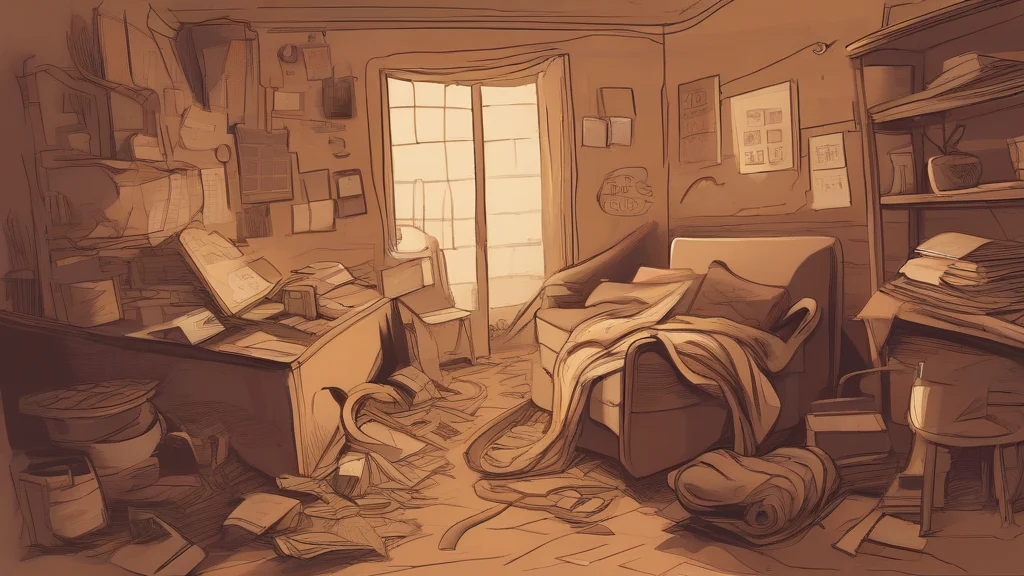
What does fankle mean?
Fankle is a vivid Scots word meaning a confused tangle or muddle, whether of physical objects or of affairs generally. As a verb, to fankle is to entangle something or to get hopelessly mixed up — a ball of wool can fankle, and so can a travel itinerary. The word is chiefly heard in Scotland and parts of northern England, where it remains a living part of everyday speech: 'I'm in a wee fankle' is a characteristically Scottish way of admitting you've made a mess of things. Its connotations are more wry than severe; a fankle suggests disarray born of confusion rather than malice, and the word often carries an affectionate, self-deprecating tone. Though unfamiliar south of the border and largely unknown in American English, fankle is precisely the kind of compact, expressive term English elsewhere lacks — one word doing the work of 'entangled mess', 'botched situation', and 'state of confusion' at once, which makes it worth borrowing even by those who did not grow up with it.
A confused tangle or muddle, either of physical things or of a situation.
"The wiring behind the desk was a complete fankle."
Often intensified as 'in such a fankle' or softened with 'wee' in Scots usage.
To entangle or confuse; to become tangled up in disorder.
"He managed to fankle the garden hose beyond repair."
The past participle 'fankled' is especially common: 'I got all fankled up in the details.'
Standard pluralization applies when referring to multiple instances of a tangle.
"The project went through several fankles before it finally came together."
In Scots, if your headphones are knotted and your plans are falling apart, one word covers it all: you're in a fankle.
Reviewed by Deb Chak, Editor. AI-assisted content curated by RJS Tech Solutions LLP.
Etymology of fankle
Fankle originates in Scots, the Germanic variety spoken in lowland Scotland, where it has been in use for several centuries. It is generally taken to be a frequentative or extended form of the older Scots noun 'fank', itself denoting a coil or twist — originally referring to a tangled lock of wool on a sheep. From this concrete sense of twisted fleece, the word broadened to any knot, snarl, or state of confusion, both literal and figurative. Its closest relatives remain within the Scots lexical tradition, and it has never spread widely into standard English.
Related word forms
How fankle is actually used
'Fankle' is informal and distinctly regional, rooted in Scots dialect; outside Scotland and northern England it is rare enough that many readers will not know it. It works both literally (knotted thread, wires) and figuratively (a botched situation), usually with a mildly affectionate or self-deprecating connotation rather than anger.
Easily confused with fankle
'Rankle' means to cause lasting resentment or irritation, whereas 'fankle' refers to a physical or figurative tangle.