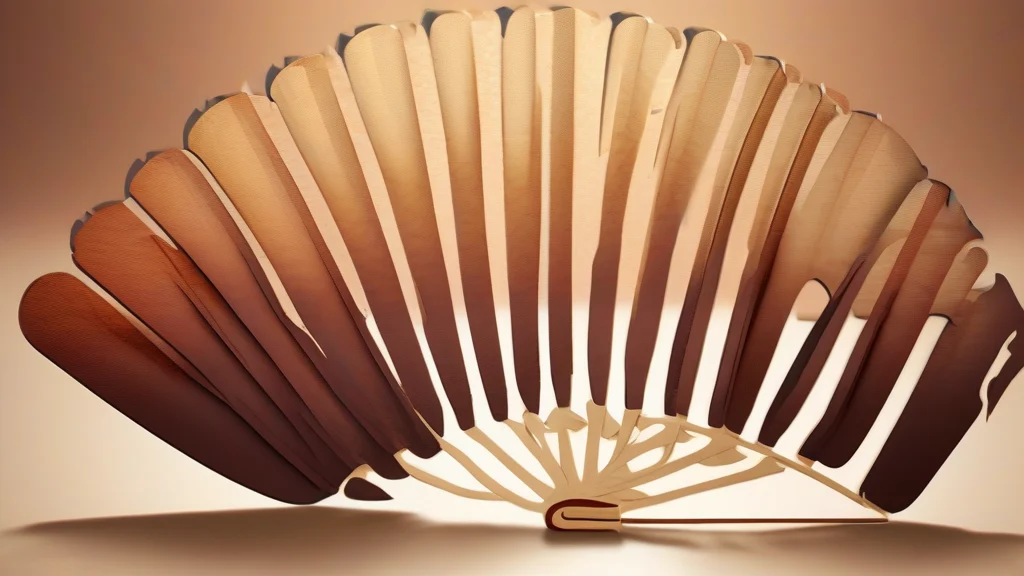
What does fanlike mean?
Fanlike is an adjective used to describe anything that spreads out from a narrow point in the manner of an open hand fan, forming a semicircle or arc. The word appears frequently in botany and zoology — ginkgo leaves are famously fanlike, as are the display tails of peacocks, the pectoral fins of many fish, and the fronds of certain palms — but it also finds use in describing architecture, geology (such as alluvial fans), and everyday objects like a fanlike arrangement of cards or papers. It carries no strong connotation beyond its literal visual meaning, making it a precise, neutral descriptor. In formal scientific contexts, the Latinate equivalents 'flabellate' and 'flabelliform' express the same idea. As a transparent compound of 'fan' plus the suffix '-like,' it requires little explanation to readers, which accounts for its steady usefulness across both popular and technical writing about form and structure.
adjectiveResembling an open hand fan in shape; spread out in a semicircular or radiating form from a narrow point of origin.
- Shaped or arranged like an open fan, radiating outward from a narrow base or point.
- (In biology/botany) Flabellate — describing leaves, fins, tails, or other structures that spread out in a semicircular form.
"The peacock's tail opened into a fanlike display that shimmered in the sunlight."
"The ginkgo tree is instantly recognizable by its distinctive fanlike leaves."
"She spread her cards into a fanlike arc across the table."
From peacock tails to ginkgo leaves to the veins in your hand, nature keeps reinventing the fan — and 'fanlike' is the word biologists reach for every time.
Reviewed by Deb Chak, Editor. AI-assisted content curated by RJS Tech Solutions LLP.
Etymology of fanlike
Fanlike is formed from 'fan,' which entered Old English as 'fann' borrowed from Latin 'vannus,' the winnowing implement used to toss grain into the air — itself perhaps related to Greek 'pteron,' wing, reflecting the implement's feathered, spreading shape. The suffix '-like' is a native English means of forming adjectives denoting resemblance, giving 'fanlike' its transparent sense of 'shaped like a fan.' The compound arose in modern English descriptive writing, particularly in natural history, where it parallels related terms such as 'leaflike' and 'featherlike.' Its Latin root also underlies 'vane' and, through the winnowing connection, 'ventilate.'
How fanlike is actually used
'Fanlike' is descriptive and largely neutral in tone, appearing most often in scientific, botanical, zoological, and architectural writing rather than everyday conversation. It functions as a compound modifier and typically precedes the noun it describes (e.g., 'a fanlike spray'). The related technical terms 'flabellate' and 'flabelliform' carry the same meaning in formal taxonomy.
Easily confused with fanlike
Finlike describes something shaped like a fish's fin (a flat, protruding appendage), whereas fanlike describes something spreading out from a point like an open fan.