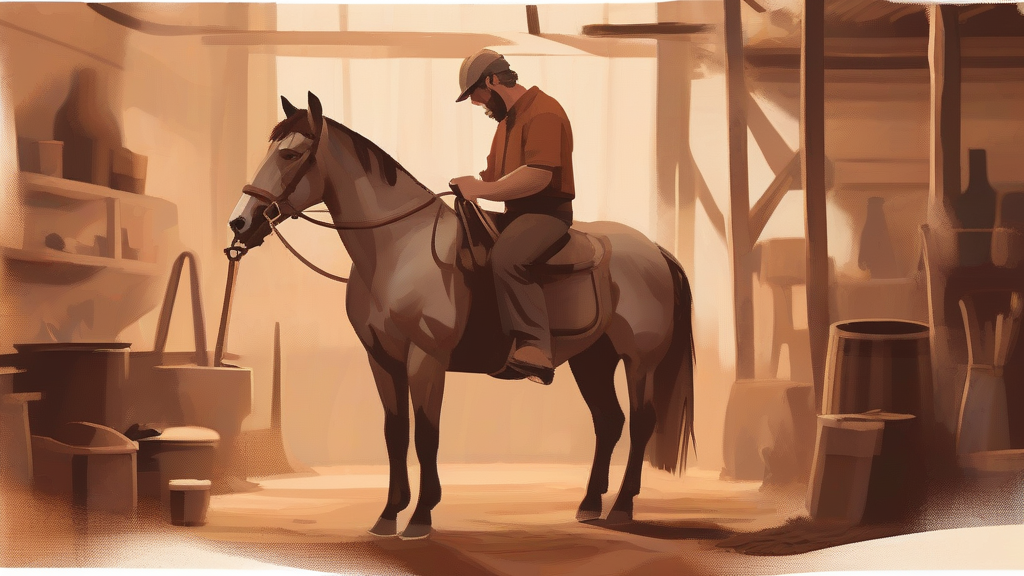
What does farrier mean?
A farrier is a skilled craftsperson who specializes in the care of horses' hooves, most notably by trimming them and fitting horseshoes. The role combines elements of blacksmithing — shaping and applying metal shoes — with detailed knowledge of equine anatomy, since poorly balanced hooves can cause lameness and long-term injury. Farriers are essential figures in the equestrian world, working with stables, racetracks, and private horse owners, typically on a schedule of roughly every four to eight weeks per animal. In several countries, including the United Kingdom, farriery is a regulated profession requiring formal training and registration. The word traces back through Old French 'ferrier' to the Latin 'ferrum', meaning iron, reflecting the trade's roots in metalwork. Though once broader in scope, today 'farrier' refers almost exclusively to equine hoof care. It should not be confused with 'furrier', which concerns furs rather than hooves, despite their similar appearance.
nounA farrier is a craftsperson who makes and fits horseshoes, and who trims and cares for horses' hooves. The term can also denote a person who works in iron or metal, though this older sense is now rare.
- A specialist who trims and shoes horses' hooves; an equine hoof-care professional.
- (Historical) A worker in iron or a smith more generally.
"The farrier came out to the stable every six weeks to shoe the mare."
"We had to call the farrier out because the gelding had thrown a shoe in the paddock."
"After qualifying as a farrier, she built a round of over two hundred clients across the county."
Standard plural form; used when referring to multiple practitioners of the trade.
"Three farriers served the racing yards around Newmarket."
Every farrier alive today is carrying on a trade whose Latin root — ferrum, iron — is the same one that gave Spain its name-bearing word 'hierro' and science its 'ferrous'.
Reviewed by Deb Chak, Editor. AI-assisted content curated by RJS Tech Solutions LLP.
Etymology of farrier
Farrier derives from the Old French 'ferrier', meaning a smith or worker in iron, which itself comes from the Latin 'ferrum', meaning iron — the same root that gives us 'ferrous' and 'ferric' in chemistry. The word entered English around the late Middle Ages or early modern period, initially denoting a smith who worked with iron, particularly in relation to horses. Over time the meaning narrowed from general ironwork to the specific trade of horseshoeing and hoof care. Related forms appear in other Romance languages, all ultimately descending from the same Latin source.
How farrier is actually used
The word is a standard occupational term in equestrian contexts, neutral in register. It is increasingly used as a certified or registered profession in Britain and elsewhere, with formal apprenticeship and qualification structures. The older general sense relating to ironworking has largely fallen away, leaving 'farrier' firmly associated with horse care.
Easily confused with farrier
A blacksmith forges objects from iron generally, whereas a farrier specializes specifically in equine hoof care and horseshoeing, though many farriers also have blacksmithing skills.
A furrier deals in furs and fur garments, while a farrier shoes horses — the two words look and sound similar but are entirely unrelated.