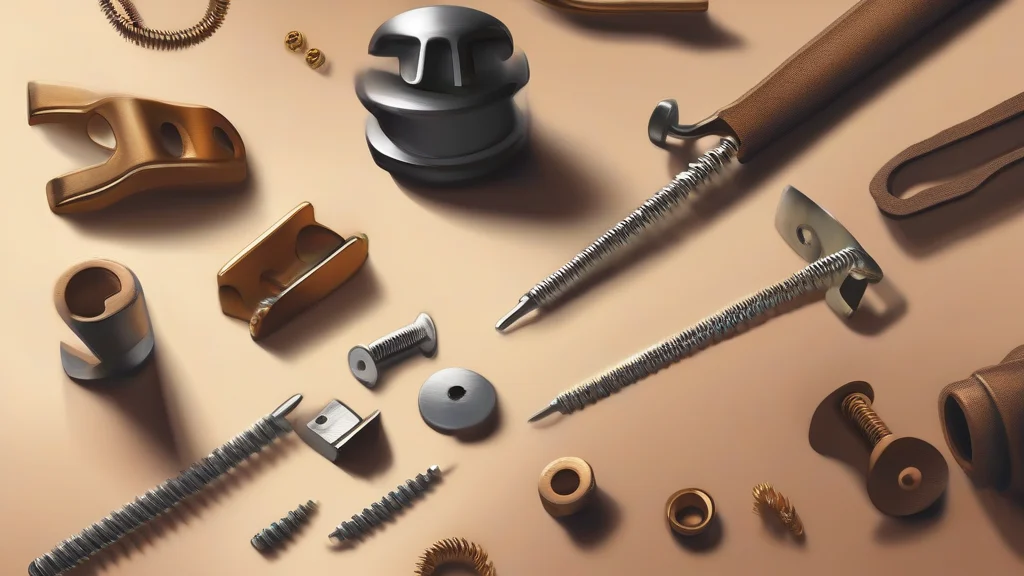
What does fastener mean?
A fastener is a device used to hold things together or keep them closed, encompassing everything from the buttons, zips, buckles, and snaps on our clothing to the screws, bolts, rivets, and nails that bind buildings and machines. The word covers both everyday garment closures and industrial hardware, making it one of those quiet workhorse terms that appears constantly in manufacturing, engineering, tailoring, and daily life without drawing attention to itself. Fasteners are typically small and functional rather than decorative, though some — an antique brooch clasp, a polished brass buckle — carry real charm. The term carries no particular connotation; it is practical, neutral vocabulary. Its usefulness lies in its breadth: rather than naming each kind of closure individually, speakers and writers can refer generically to fasteners, whether discussing a broken zip on a suitcase or the thousands of bolts securing an aircraft fuselage.
nounA device or object, such as a button, zipper, buckle, or clasp, used to fasten two things together or to keep something closed or secured.
- A physical device (button, zip, buckle, clasp, snap) used to close or secure clothing, bags, or other objects.
- More broadly, any hardware component such as a screw, bolt, nail, or rivet used to join materials together.
"The tailor replaced the broken fastener on the jacket with a sturdy brass zip."
"She checked every fastener on her rucksack before setting off up the mountain."
"The engineer specified corrosion-resistant fasteners for the bridge's steel joints."
Standard plural; frequently used when referring collectively to hardware supplies.
"The kit comes complete with all the screws and fasteners you will need."
The humble zipper — perhaps the world's most famous fastener — was rejected by tailors for decades before conquering everything from trousers to spacesuits.
Reviewed by Deb Chak, Editor. AI-assisted content curated by RJS Tech Solutions LLP.
Etymology of fastener
Fastener derives from 'fasten', which comes from Old English 'fæstnian', meaning to make firm or secure, itself rooted in 'fæst' (firm, fixed). That Old English adjective traces back to Proto-Germanic origins shared by related words in German and other Germanic languages, such as German 'Fest' and 'festmachen'. The noun 'fastener', denoting the securing device itself, emerged later, becoming common as manufactured closures and hardware proliferated during the nineteenth century.
Related word forms
How fastener is actually used
Common and neutral in everyday use. In British English, 'zip fastener' is a traditional term for a zipper; in American English 'fastener' more often refers broadly to hardware like screws and bolts as well as to garment closures.
Easily confused with fastener
A fastener is a hardware device that joins or closes things; fasting is the act of abstaining from food — the words merely share a root in 'fast' in unrelated senses of that word.