
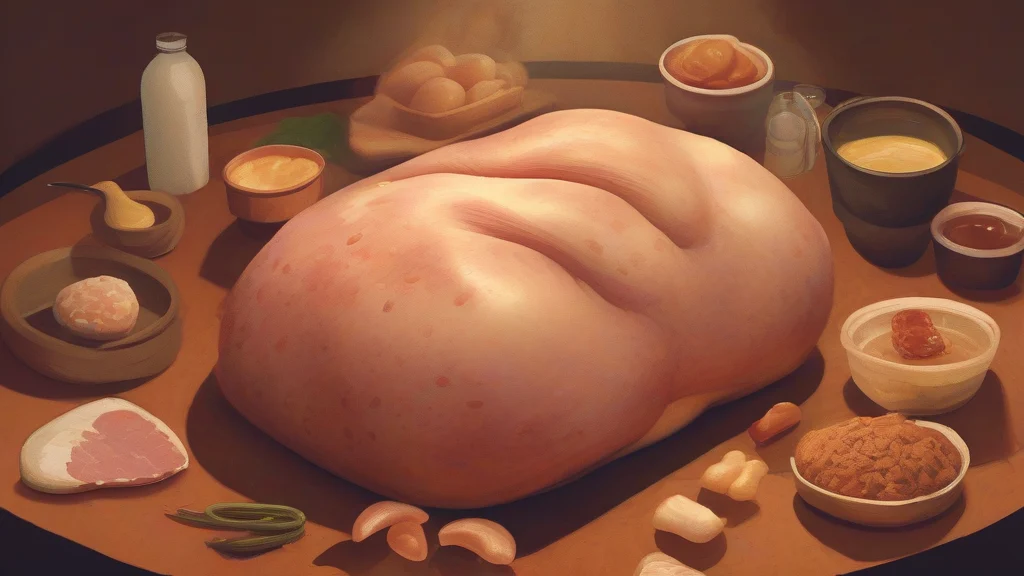
What does fat mean?
Fat is one of those rare English words that functions comfortably as an adjective, a noun, and — less commonly today — a verb. As an adjective it describes someone carrying excess body weight, though this use can sound harsh or impolite, and speakers often soften it to words like overweight or plump. It also describes anything thick or ample, from a fat wallet to a fat volume of essays. As a noun, fat names the oily tissue stored in living bodies and the greasy component of many foods, where it serves as a vital source of energy and flavor. Figuratively, fat suggests richness and abundance: the fat of the land, a fat paycheck, a fat inheritance. Idioms add color — 'a fat chance' ironically means almost none, and 'chewing the fat' means chatting casually. Derived forms such as fatten, fatty, and fatness extend its range across everyday, culinary, and medical language.
Having much flesh on the body; overweight; also, thick or abundant.
"A fat tabby cat dozed in the shop window all afternoon."
An oily, greasy substance found in animal bodies and in many seeds and foods, valued as an energy source.
"Butter is nearly pure milk fat."
To make or become fat; in modern English usually expressed through 'fatten'.
"The farmers fattened the cattle before market."
As a noun, fats refers collectively to different kinds of fat substances, most often in nutritional or scientific contexts.
"Nutritionists recommend limiting saturated fats in the diet."
"Fat chance" almost always means "no chance at all" — one of English's most delightfully sarcastic idioms.
Reviewed by Deb Chak, Editor. AI-assisted content curated by RJS Tech Solutions LLP.
Etymology of fat
Fat comes from Old English fǣtt, which literally meant 'fattened', the past participle of a verb related to fattening livestock. The word shares a common Germanic ancestry with terms connected to nourishing and feeding, making it a distant relative of words like food and feed. Its core senses — plumpness and grease — have remained remarkably stable for over a thousand years.
Related word forms
How fat is actually used
Describing people as fat is widely considered blunt or offensive in polite conversation; neutral alternatives include 'overweight', while medical contexts use 'obese'. In informal speech, 'fat' applied to things (a fat salary, a fat stack of bills) carries positive connotations of abundance. The verb sense has largely been replaced by 'fatten'.
Easily confused with fat
Phat is slang from the 1990s meaning excellent or attractive, whereas fat describes size or grease content; the two sound identical but share no etymology.