
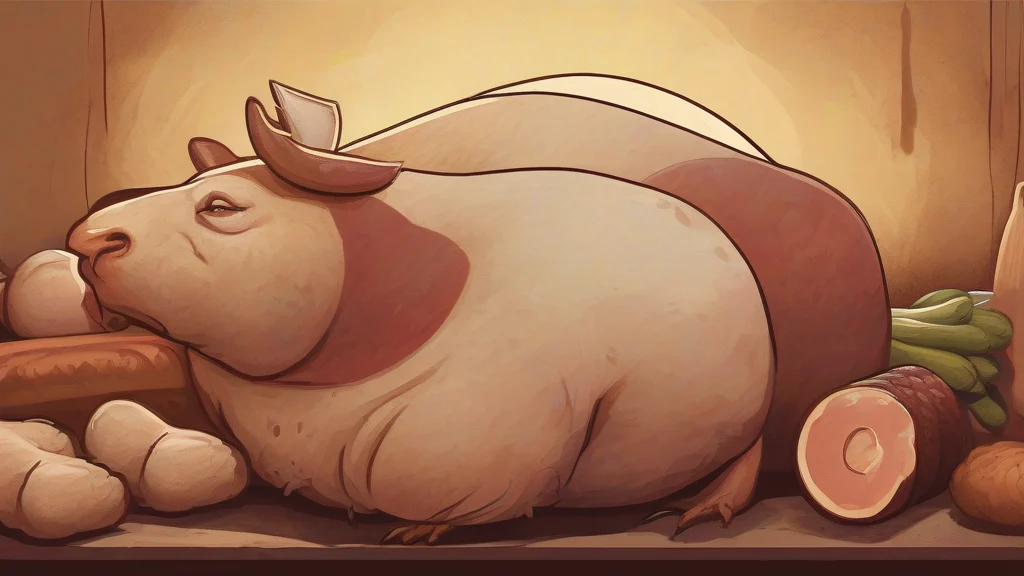
What does fattened mean?
'Fattened' describes something — most often an animal — that has been made plump or heavy through deliberate feeding. Its primary use is agricultural: cattle, pigs, geese, and other livestock are fattened on grain or rich feed to prepare them for slaughter or market. By extension, the word appears in figurative contexts, where profits, budgets, or bank accounts are said to be fattened, usually with a hint that this enrichment may be excessive or self-serving. The word is best known through the ancient idiom 'to kill the fatted calf', drawn from the biblical parable of the Prodigal Son, in which a father celebrates his son's return by slaughtering a well-fed animal for a feast; today the phrase means to celebrate lavishly or welcome someone home generously. Grammatically, 'fattened' serves as both the past tense and past participle of the verb 'fatten' and as an attributive adjective, as in 'a fattened goose'. Its connotations range from wholesome abundance in farming to implied greed in financial usage.
Past tense and past participle of 'fatten': to have made an animal or person plumper by feeding, or to have made something richer or more substantial.
"They fattened the geese through the autumn months."
Commonly followed by 'up' in modern usage.
Describing an animal or thing in a state of having been fed to plumpness, as in 'a fattened calf'.
"A fattened pig awaited the winter festival."
The phrase 'kill the fatted calf' comes straight from the Prodigal Son parable — over two thousand years old and still the go-to idiom for extravagant celebration.
Reviewed by Deb Chak, Editor. AI-assisted content curated by RJS Tech Solutions LLP.
Etymology of fattened
'Fattened' derives from the verb 'fatten', formed in Middle English from the Old English adjective 'fætt', meaning 'fat' — itself from a Proto-Germanic root related to the notion of being well-fed or stuffed. The compound verb 'fatten' arose as a natural English formation using the native suffix '-en', meaning 'to make or become', so the word's lineage is entirely Germanic rather than Latinate. Cognate forms appear across Germanic languages, including German 'fett'. The past participle 'fattened' has long served double duty as a verb form and an adjective, cemented in English usage by centuries of agricultural practice and by its prominent role in the biblical idiom of the fatted calf.
Related word forms
How fattened is actually used
'Fattened' carries neutral, practical connotations in agricultural contexts, but figurative uses often imply excess, indulgence, or self-enrichment at others' expense. In religious and literary tradition, the 'fattened calf' signals celebration and welcome rather than greed. The word functions chiefly as the past form of the verb 'fatten', but it also stands alone as an adjective before nouns.
Easily confused with fattened
'Fated' means determined by destiny or doom, while 'fattened' means made plump or heavier through feeding.