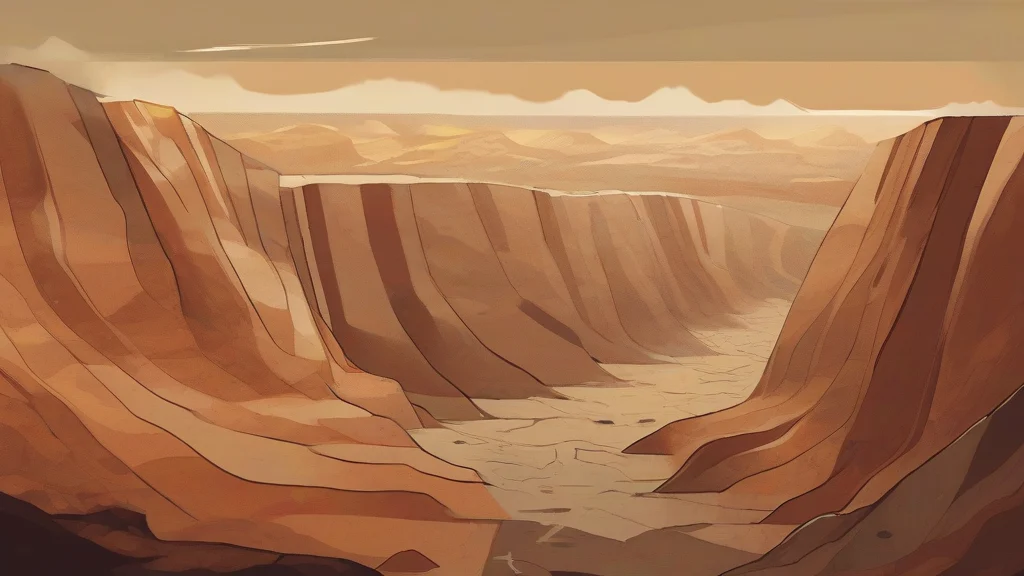
What does faulting mean?
Faulting is primarily a geological term describing the process by which rocks fracture and blocks of the Earth's crust slip past one another along planes known as faults. It occurs when tectonic stresses exceed the strength of rock, producing features that range from small cracks to vast mountain-forming structures such as those found along the San Andreas Fault in California or the rift valleys of East Africa. Geologists classify faulting into types — normal, reverse, thrust, and strike-slip — depending on the direction in which the rock blocks move. Beyond geology, faulting also serves as the gerund of the verb 'fault', meaning to blame or criticize, though this sense appears mainly in formal contexts. The word carries no strong emotional charge itself, but its associations run deep: much of our understanding of earthquakes comes directly from studying faulting. It is an essential term for anyone interested in how the planet's surface is shaped over time.
nounThe process in geology by which rock fractures and blocks of the Earth's crust are displaced relative to one another along faults; more broadly, the action of blaming or criticizing someone (as the gerund of the verb 'fault').
- Geology: the fracturing and displacement of rock along faults in the Earth's crust.
- As the gerund of 'fault': the act of blaming or finding criticism with someone or something.
"The region's dramatic landscape was shaped by millions of years of faulting."
"Seismologists mapped centuries of faulting along the San Andreas zone."
"He was quick to point fingers, but constant faulting of colleagues won him few friends."
Every earthquake you've ever heard of is the sound of faulting in action — the Earth's crust cracking and slipping under pressure.
Reviewed by Deb Chak, Editor. AI-assisted content curated by RJS Tech Solutions LLP.
Etymology of faulting
Faulting derives from 'fault', which entered English in the late Middle Ages through Old French 'faute', itself from Vulgar Latin *fallita, a derivative of Latin 'fallere', meaning to deceive or fail. The geological application arose in the nineteenth century as mining terminology: miners spoke of a 'fault' where a mineral vein was interrupted, and the word extended to describe the broader process of crustal displacement. Cognates include 'default', 'failure', and 'fallacy', all tracing back to the same Latin root of failing or deceiving.
Related word forms
How faulting is actually used
The geological sense is by far the dominant modern usage and is standard technical vocabulary in earth sciences. The gerundial sense from the verb 'fault' (to blame) is less common and tends to appear in formal or literary writing; 'finding fault' is the more idiomatic phrasing for habitual criticism.
Easily confused with faulting
'Foul' means offensive or dirty (or an infraction in sport), whereas 'faulting' derives from 'fault', meaning a defect or responsibility for error.
In geology, folding bends rock layers without breaking them, while faulting fractures rock and displaces the blocks on either side.