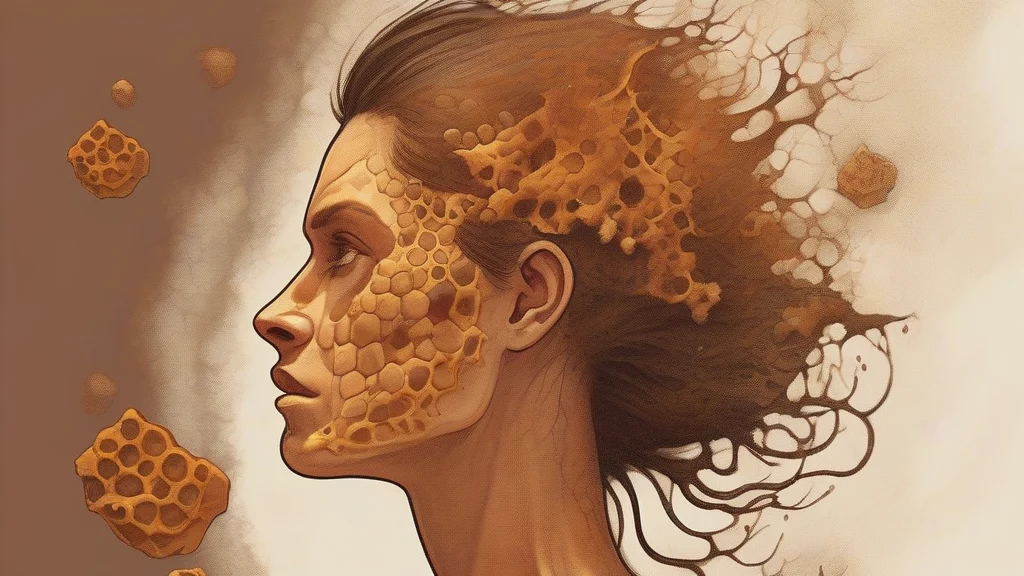
What does favus mean?
Favus is a chronic fungal infection of the scalp, medically known as tinea favosa, caused chiefly by the fungus Trichophyton schoenleinii. Its hallmark is the formation of thick, yellowish crusts called scutula that cluster into honeycomb-like lesions, destroying hair follicles and often leaving permanent scarring with hair loss. The name derives directly from the Latin word for honeycomb, an image early physicians found apt when describing the diseased scalp's distinctive texture. Once relatively widespread in Europe and elsewhere, favus has become rare in regions with good hygiene and antifungal treatment, though it persists in some parts of the world. Today the word survives almost entirely in medical literature, dermatology textbooks, and accounts of historical disease, where it serves as a precise label for this once-common affliction rather than a term encountered in everyday conversation.
A chronic fungal infection of the scalp caused by Trichophyton schoenleinii, marked by honeycomb-like crusts (scutula), follicular destruction, and permanent scarring hair loss.
"Favus, though now uncommon, remains endemic in certain rural communities."
Used in clinical contexts; the adjectival phrase 'tinea favosa' names the same condition.
In classical Latin usage, a honeycomb constructed by bees.
"The Roman farmer lifted the favus from the hive, heavy with summer honey."
This sense belongs to Latin rather than modern English and appears mainly in translations and scholarly writing.
In medical writing, 'favus' usually functions as a mass noun referring to the condition and is left uninflected; when a count plural is needed, the anglicized 'favuses' is standard.
"Early twentieth-century hospital records describe numerous favuses treated in the pediatric ward."
Doctors named this scalp disease after a honeycomb — because under examination, the infected skin literally looks like one.
Reviewed by Deb Chak, Editor. AI-assisted content curated by RJS Tech Solutions LLP.
Etymology of favus
The English word 'favus' was borrowed in the 19th century from Latin 'favus', meaning 'honeycomb', which physicians applied to the disease because of its characteristic honeycomb-patterned crusting. The Latin noun is related to the verb 'favēre', 'to regard with favor', a link ancient Romans may have felt through the sweetness and good fortune associated with honey. English words such as 'favor' and 'favorite' trace back through that same Latin verb, making them distant relatives of 'favus'.
Related word forms
How favus is actually used
Today 'favus' is used almost exclusively as a technical term in dermatology and medical history; it is formal register. The classical sense ('honeycomb') appears mainly in Latin texts and historical or literary writing. The adjective forms 'favose' and 'favous' are rare and largely confined to older medical literature.
Easily confused with favus
Although both derive ultimately from the same Latin root family, 'favor' means goodwill or approval, whereas 'favus' is a honeycomb or, in medicine, a fungal scalp infection.