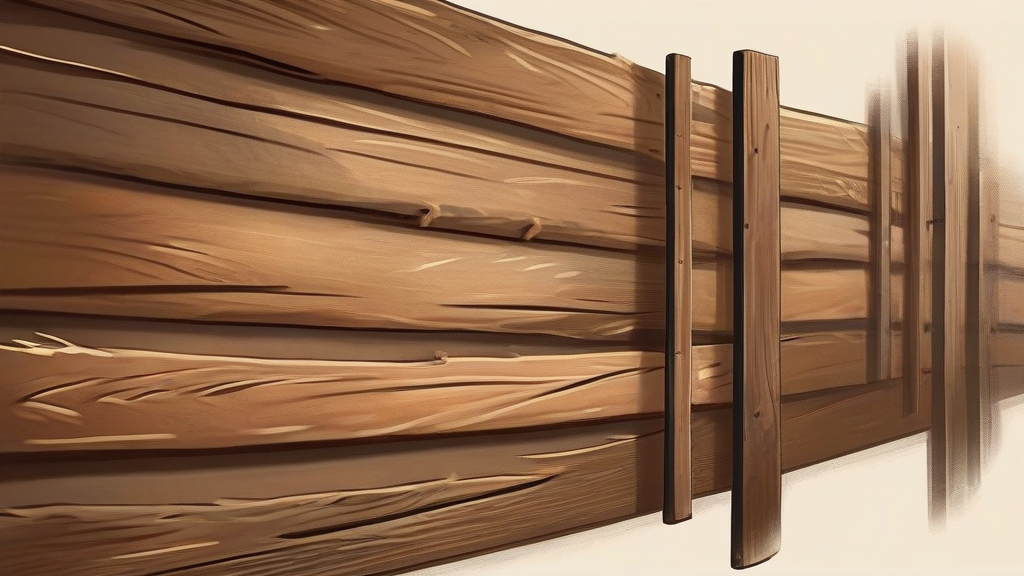
What does featheredge mean?
A featheredge is a thin, tapering edge — one that has been planed, shaved, or ground down until it diminishes almost to nothing, like the vane of a feather. The term arises most often in woodworking and construction: a craftsman may plane a board to a featheredge so it sits flush against another surface, while builders use featheredge boards, which are sawn with one thick edge and one thin one, so that successive pieces can overlap neatly as fencing or cladding that sheds water. The word can therefore refer either to the tapered edge itself or to timber cut in this way. Its register is practical and technical rather than literary, and it appears mainly in British and American trade contexts, with British usage particularly associated with close-boarded garden fencing. Figuratively, being reduced "to a featheredge" suggests extreme delicacy or near-vanishing thinness. For anyone interested in craft, building, or precise descriptive vocabulary, featheredge captures in a single compound word both a physical technique and the elegant result it produces.
nounA thin, tapering edge, especially the edge of a board or plank shaved down so that it tapers almost to nothing at one side. In construction, it also refers to boards sawn with such an edge so they can be overlapped neatly.
- A thin, tapering edge on a piece of material such as wood or stone.
- A board (especially for fencing or cladding) sawn with one thick and one thin edge so pieces can overlap.
"The carpenter planed each board to a featheredge so the joints would sit flush."
"He sanded the plaster down to a featheredge before painting."
"The garden fence was built from rough-sawn featheredge boards."
The plural is uncommon outside trade writing, where it typically refers to multiple featheredge boards.
"The yard stacked fresh featheredges ready for the new fence."
"Featheredge" is exactly what it sounds like: wood planed down so thin and delicate at the edge that it's compared to the shaft of a feather.
Reviewed by Deb Chak, Editor. AI-assisted content curated by RJS Tech Solutions LLP.
Etymology of featheredge
Featheredge is a straightforward English compound of "feather" and "edge," formed from native Germanic roots and first recorded in the early modern period, around the seventeenth century. The name is pictorial: the taper of the worked edge recalls the slender quill of a feather. Because it is a transparent compound rather than a borrowed term, its cognates are simply other words built on "feather" and "edge," such as featherweight and featherbed.
Related word forms
How featheredge is actually used
The word is chiefly technical, appearing in carpentry, joinery, masonry, and fencing contexts; in British usage "featheredge" strongly connotes overlapping garden fencing boards. It carries no strong connotation beyond precision and lightness of finish.
Easily confused with featheredge
A weatherboard is a whole cladding board designed to shed rain, while featheredge describes the thin, tapering cut of a board's edge — though featheredge boards are often used as cladding.