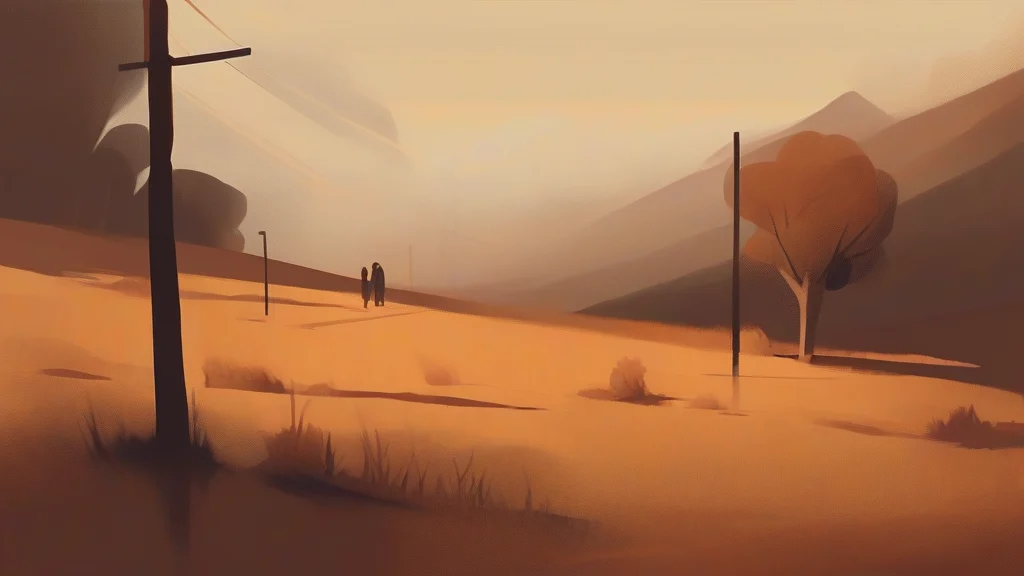
What does featureless mean?
Featureless is an adjective describing something that lacks distinctive features, marks, or qualities — a surface, landscape, building, face, or expression so uniform that nothing about it stands out or aids recognition. A featureless plain offers no landmark by which to navigate; a featureless grey sky shows no variation in cloud or light; a featureless voice betrays no emotion. The word carries a mildly negative connotation of blandness, monotony, or anonymity, though it can be used neutrally as a purely descriptive term. It derives from the noun 'feature', which entered English from French and ultimately from Latin 'factura', meaning 'a making or fashioning', combined with the suffix '-less', meaning 'without'. Common pairings include 'featureless landscape', 'featureless plain', and 'featureless expanse'. The word is useful precisely because it compresses a whole impression — emptiness, sameness, lack of character — into a single economical term.
adjectiveLacking distinctive features or characteristics of interest; having no notable or individual qualities. Often used to describe landscapes, faces, or surfaces that are uniform, plain, and unremarkable.
- (of a place, surface, or landscape) lacking distinctive features; uniform and unremarkable.
- (of a person's face or expression) showing no emotion or individuality.
"They drove for hours across a featureless expanse of flat, grey moorland."
"The ship sailed on through a featureless sea beneath an overcast sky."
"He gave a featureless smile that revealed nothing of what he was thinking."
Featureless is one of those rare words that does exactly what it says: it strips a thing of every trait worth mentioning — which is precisely what makes it so vivid.
Reviewed by Deb Chak, Editor. AI-assisted content curated by RJS Tech Solutions LLP.
Etymology of featureless
Featureless was formed within English from the noun 'feature' plus the suffix '-less', meaning 'without'. The noun 'feature' came into Middle English from Old French 'faiture', from Latin 'factura', meaning 'a making or fashioning', derived from the verb 'facere', 'to make or do'. English writers have used 'featureless' since at least the early nineteenth century to describe terrain and, later, faces and expressions. It shares this Latin root with words such as 'facture' and 'feat', all pointing back to the idea of something made or shaped.
How featureless is actually used
The word is neutral in register and appears in both formal and everyday writing. It most frequently describes physical spaces (terrain, skies, buildings) but is also applied figuratively to faces, voices, or writing that lacks personality. Its connotation is mildly negative, implying dullness or anonymity rather than simple simplicity.
Easily confused with featureless
'Flawless' means perfect or without defects, while 'featureless' means lacking distinguishing features or character — a featureless thing is not necessarily flawed, just undistinguished.