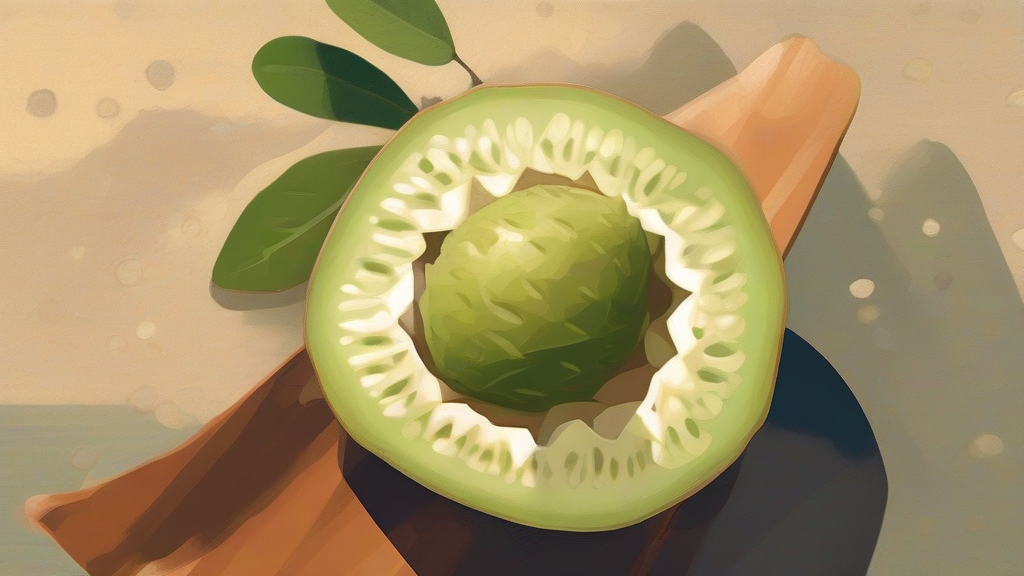
What does feijoa mean?
The feijoa is a small, oval, green-skinned fruit about the size of an egg, with gritty, jelly-like flesh that has a sweet, aromatic flavour often compared to a blend of pineapple, guava, and mint. It grows on Acca sellowiana, an evergreen shrub of the myrtle family native to southern Brazil, Uruguay, Paraguay, and Argentina, which is also grown ornamentally for its striking red-edged flowers and is commonly called pineapple guava or guavasteen. The word itself honours João da Silva Feijó, a Portuguese-born Brazilian botanist. Feijoas are especially popular in New Zealand and Australia, where home gardens routinely feature a feijoa hedge and the seasonal crop inspires jams, chutneys, wines, and desserts. Because the fruit bruises easily and does not ripen well off the tree, it remains largely a regional delicacy rather than a global supermarket staple, which only adds to its cult appeal among those who grow it.
An edible, egg-shaped green fruit with sweet aromatic flesh, borne on a South American shrub of the myrtle family (Acca sellowiana).
"Scoop the feijoa out of its skin with a spoon and eat it fresh."
Often referred to in North America and Britain as 'pineapple guava'.
The evergreen shrub Acca sellowiana itself, grown both for its fruit and as an ornamental hedge plant with showy flowers.
"A dense feijoa makes an attractive, wind-tolerant hedge in coastal gardens."
Standard plural, used when referring to multiple fruits or plants.
"The tree dropped a dozen feijoas overnight."
The feijoa is named after a real person — the Brazilian botanist João da Silva Feijó — and New Zealanders love it so much that many treat it as their unofficial national fruit.
Reviewed by Deb Chak, Editor. AI-assisted content curated by RJS Tech Solutions LLP.
Etymology of feijoa
The word 'feijoa' comes from the modern botanical Latin genus name Feijoa, coined in honour of João da Silva Feijó, an eighteenth-century Portuguese-born naturalist who collected plants in Brazil. The genus has since been reclassified as Acca, but the common name preserves his memory. The fruit's alternative English names, pineapple guava and guavasteen, reflect its flavour resemblance to other fruits rather than any close kinship with them.
How feijoa is actually used
The word is most familiar in New Zealand and Australia, where the fruit is widely grown and eaten, and in parts of South America; in Britain and North America it is less common and often encountered under the alternative name 'pineapple guava'. The plural is simply 'feijoas'.
Easily confused with feijoa
Despite the nickname 'pineapple guava', the feijoa is not a true guava; it belongs to a different genus within the same myrtle family and has a distinctive aromatic flavour of its own.