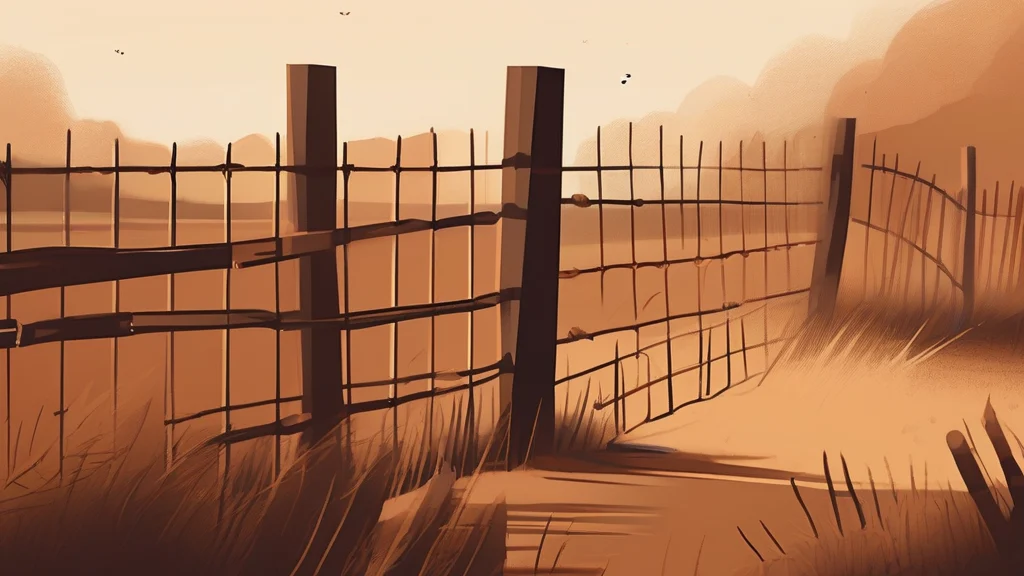
What does fence mean?
A fence is a man-made barrier — typically of wood, wire, metal, or living plants — erected to enclose, divide, protect, or mark an area of land. Fences range from simple picket structures around suburban gardens to extensive wire boundaries on farmland, and they serve practical purposes of security, privacy, containment of livestock, and the demarcation of property lines. The word also functions as a verb meaning to erect such a barrier, as in 'they fenced the field', and gives its name to fencing, the sport of sword fighting, whose protective barrier gave the activity its title. Figuratively, 'to sit on the fence' has become one of English's most familiar idioms for hesitating between choices. Derived from an abbreviated form of 'defence', the word carries connotations of boundary-keeping and protection, making it useful in both literal and metaphorical contexts.
A structure of posts, rails, wire, or boards serving as a barrier or enclosure for an area of land.
"The horse leaned over the fence to reach the greener grass."
Distinct from a wall, which is typically a solid mass of brick, stone, or concrete.
To enclose or separate an area of land with a barrier; also, to practise the sport of fighting with light swords.
"The farmer fenced off the stream to protect the banks."
In the sword-fighting sense, usually encountered in the context of the sport of fencing.
Standard plural, pronounced /ˈfɛnsɪz/. Used when referring to multiple barriers, as in describing a landscape or comparing properties.
"White fences stretched for miles along the country road."
'Fence' is actually just 'defence' with its head chopped off — medieval speakers wore the word down to three syllables' worth of shorthand.
Reviewed by Deb Chak, Editor. AI-assisted content curated by RJS Tech Solutions LLP.
Etymology of fence
Fence originated in the fifteenth century as a shortened form of 'defence', the result of a process called aphesis, in which unstressed initial syllables drop away. It ultimately traces back to Latin 'defendere', meaning to ward off or protect, the same root that gives us defend, fend, and offence-related terms. Its sense narrowed from protection in general to physical barriers, and by the seventeenth century it was also applied to the art of swordplay because fencers defended themselves behind their blades.
Related word forms
How fence is actually used
As a noun, 'fence' is neutral in register and common in everyday speech; it usually refers to barriers around gardens, yards, and fields, distinct from a 'wall', which is typically solid masonry. The idiom 'to sit on the fence' means to remain undecided, and is common in both British and American English. In British English, 'fence off' is frequent for dividing land.
Easily confused with fence
'Fens' are wetland marshes, while a 'fence' is a man-made barrier; the words differ in vowel sound and meaning.