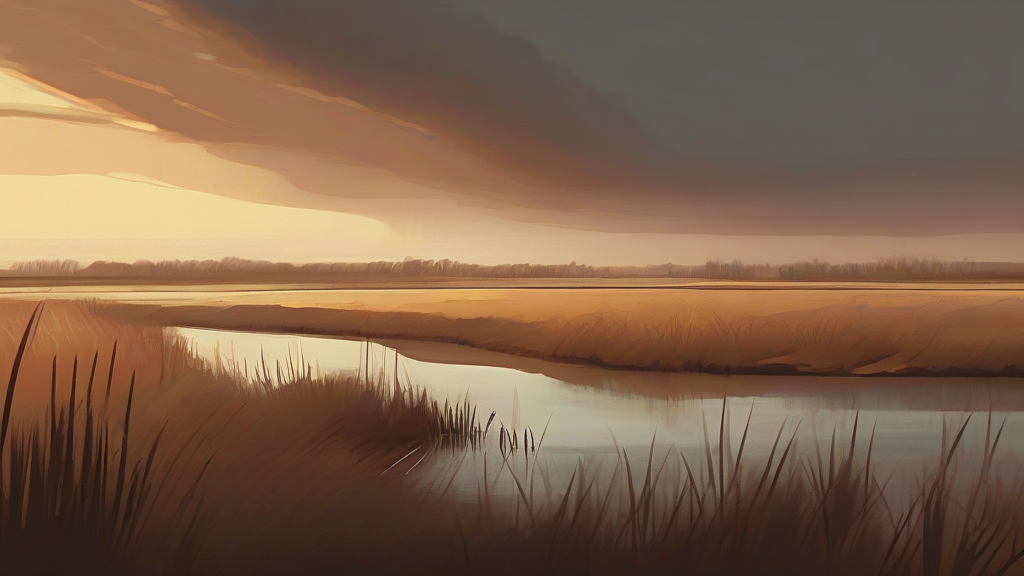
What does fenland mean?
Fenland refers to low-lying, marshy ground of the kind found in fens — wetlands fed by groundwater rather than rainwater alone. In its capitalized form, Fenland names the famously flat region of eastern England surrounding the Wash, spanning parts of Cambridgeshire, Lincolnshire, and Norfolk. This area was once a vast, waterlogged swamp, but from the seventeenth century onward, large-scale drainage schemes — notably led by the Dutch engineer Cornelius Vermuyden — transformed it into some of Britain's richest arable farmland. As a result, fenland often connotes both fertile dark soils and an eerie, exposed flatness punctuated by drainage ditches, dykes, and ruined wind pumps. The word is chiefly British in usage, appearing frequently in discussions of agriculture, ecology, and local history, and it evokes a distinctive landscape shaped as much by human engineering as by nature.
nounLand consisting of or reclaimed from a fen; low-lying marshy ground. When capitalized (Fenland), it refers to the flat, formerly marshy region of eastern England around the Wash, in Cambridgeshire, Lincolnshire, and Norfolk.
- Low-lying marshy or boggy land, especially land drained and reclaimed for agriculture.
- (Capitalized, Fenland) The region of eastern England around the Wash known for its flat, reclaimed terrain.
"The cyclists pedalled steadily across the fenland, the rich dark soil stretching to a horizon broken only by drainage ditches and wind pumps."
"Much of the fenland lies below sea level, protected by dykes and pumping stations."
"Her novel captures the brooding isolation of life in the Fenland before modern drainage."
Rarely pluralized since the word already denotes a tract of land; the plural appears mainly when referring collectively to several such regions.
"The fenlands of East Anglia differ markedly from the peat bogs of Ireland."
England's Fenland was once a treacherous watery wilderness until seventeenth-century Dutch engineers drained it into some of Britain's most fertile farmland.
Reviewed by Deb Chak, Editor. AI-assisted content curated by RJS Tech Solutions LLP.
Etymology of fenland
Fenland combines 'fen', an Old English word (fenn) meaning marsh or bog, with 'land'. The Old English term has cognates in other Germanic languages, including Dutch veen and German Fenn, pointing to a shared Germanic root describing waterlogged ground. The compound arose in English to describe both generic marshy terrain and, later, the specifically named region of eastern England.
How fenland is actually used
The word carries a distinctly British flavour and appears most often in writing about eastern England's geography, agriculture, and history. In lowercase it denotes any fen-type terrain; capitalized, it names the specific English region.
Easily confused with fenland
Finland is a Nordic country in northern Europe, while fenland is simply low-lying marshy terrain — the two merely share a similar sound.