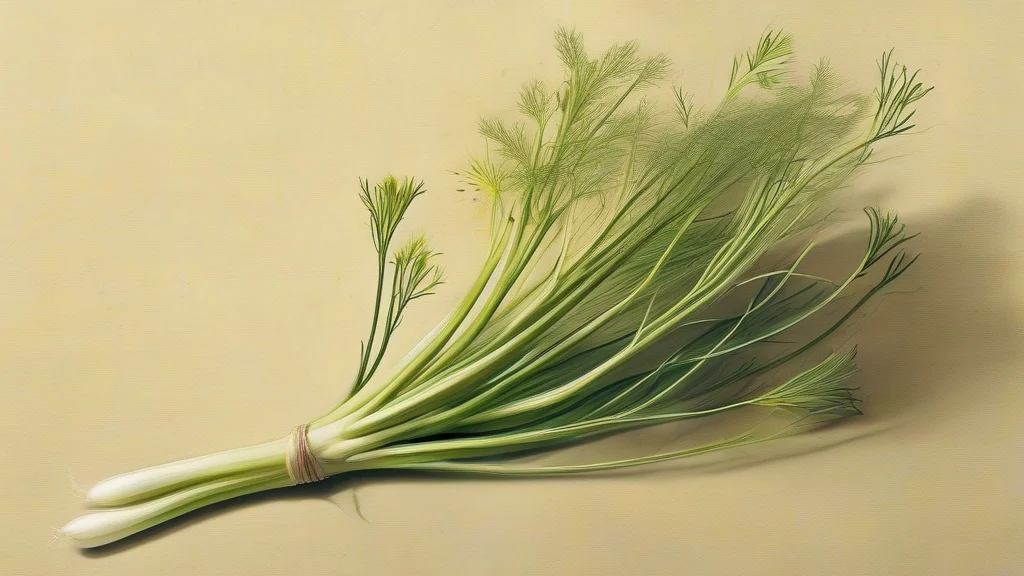
What does fennel mean?
Fennel is an aromatic perennial plant of the carrot family, native to the Mediterranean region and now grown widely throughout the world. It is prized in the kitchen from root to seed: the crisp white bulb is eaten raw in salads or roasted as a vegetable, the feathery green fronds serve as a garnish much like dill, and the small oval seeds lend a warm, sweet, liquorice-like flavour to breads, sausages, and spice blends. All parts share a distinctive taste reminiscent of anise, with which fennel is often compared though botanically unrelated as a source of that flavour. Beyond cuisine, fennel has a long history in traditional medicine, where it has been used to ease digestion and freshen breath. The word itself descends from Old English through Latin faeniculum, a diminutive meaning 'little hay', a nod to the plant's pale, hay-like foliage.
nounA perennial aromatic plant of the carrot family (Foeniculum vulgare), with feathery leaves and yellow flowers, whose bulblike base, stalks, leaves, and seeds are used as a culinary herb and vegetable. Its seeds have a sweet, anise-like flavour.
- The plant Foeniculum vulgare, cultivated for its aromatic bulb, feathery leaves, and anise-flavoured seeds.
- The edible bulb or seeds of this plant, used as a vegetable, herb, or spice.
"She roasted the salmon on a bed of sliced fennel and lemon."
"Thinly shave the raw fennel and toss it with orange segments and olive oil."
"Chew a few fennel seeds after a heavy meal to freshen the breath."
The plural is rare; fennel is usually treated as a mass noun when referring to the herb, seeds, or sliced vegetable, and the plural appears mainly when counting whole bulbs.
"Buy two fennels at the market so we have enough for the salad."
In Greek myth, Prometheus was said to have stolen fire from the gods using a hollow stalk of fennel — which is why the plant's scientific name, Foeniculum, has nothing to do with the theft but everything to do with hay.
Reviewed by Deb Chak, Editor. AI-assisted content curated by RJS Tech Solutions LLP.
Etymology of fennel
Fennel derives from the Old English fenol or finul, borrowed from Latin faeniculum (also spelled foeniculum), a diminutive of faenum meaning 'hay', likely referring to the plant's fine, hay-like leaves. The same Latin root survives in fenugreek, another herb whose name comes from faenugraecum, 'Greek hay'. The word has been in continuous use in Germanic languages since early medieval times.
How fennel is actually used
Fennel is almost exclusively used in culinary, botanical, and herbal-medicine contexts. In cooking, it helps to specify which part is meant — bulb, fronds (leaves), or seeds — since they are used quite differently.
Easily confused with fennel
A funnel is a cone-shaped tool for pouring liquids or directing flow, while fennel is an aromatic plant used in cooking.