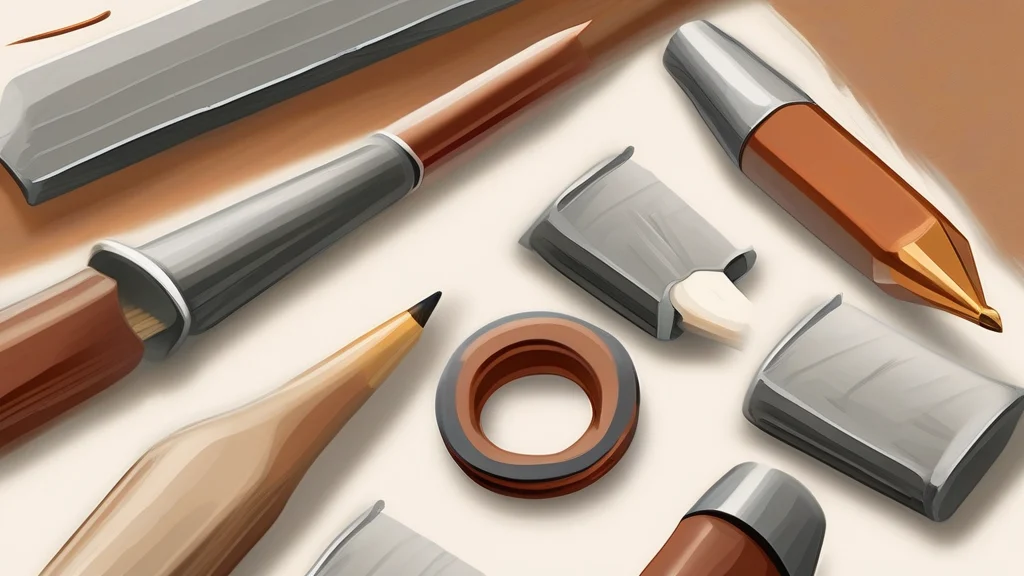
What does ferrule mean?
A ferrule is a small but essential piece of hardware: a cap, band, or collar — usually metal, sometimes rubber or plastic — fitted tightly around the end of an object to keep it from splitting, wearing down, or coming apart. Most people handle ferrules daily without knowing the word: the metal sleeve gripping a pencil's eraser, the pointed tip of an umbrella, the brass end of a cane, and the rings joining sections of a fishing rod are all ferrules. In plumbing and electrical work, ferrules also serve as connectors that crimp wires or seal joints. The word comes ultimately from Latin viriola, a little bracelet, having reached English by way of French around the early seventeenth century. Though technical in register, 'ferrule' rewards writers and readers alike with exactness: once known, it names a ubiquitous object that otherwise goes undescribed, and it should be carefully distinguished from 'ferule', the historical schoolroom rod with which it shares a spelling but not an origin.
A cap, band, or collar of metal, rubber, or plastic fitted around the end of a rod, stick, pipe, or handle to strengthen it, prevent splitting, or join it to another part.
"Each section of the bamboo fishing rod slid into a slim nickel-silver ferrule."
Common in trade and craft contexts: plumbing (compression fittings), angling (rod joints), stationery (pencil eraser bands), and restoration work.
To provide or reinforce the end of an object with a ferrule.
"The workshop ferruled each chair leg to stop the wood from splaying."
Inflected forms 'ferruled' and 'ferruling'; considerably rarer than the noun.
Regular plural; standard in both British and American English.
"The hardware shop stocked brass ferrules in a dozen sizes."
That little metal band holding the eraser on your pencil has a name — and its ancestor was a Roman bracelet.
Reviewed by Deb Chak, Editor. AI-assisted content curated by RJS Tech Solutions LLP.
Etymology of ferrule
Ferrule entered English in the early seventeenth century from French virole (also ferule in altered form), meaning a little ring or band, itself borrowed from Latin viriola, the diminutive of viria, a pair of bracelets. The spelling was influenced through folk etymology by Latin ferrum, 'iron', fitting for a word so often bound up with metalwork. Its true cognate in modern English usage is the rare architectural term virole, a ring-shaped moulding.
Related word forms
How ferrule is actually used
Ferrule is a technical or trades-oriented term, most at home in discussions of woodworking, plumbing, fishing tackle, stationery, and antique restoration. It carries no emotional connotation, though it can lend writing a pleasing precision. The spelling 'ferule', meaning a punitive rod, is a separate word and should not be substituted.
Easily confused with ferrule
A 'ferule' (from Latin ferula, giant fennel) is a flat ruler-like rod historically used to punish schoolchildren, whereas a 'ferrule' is the reinforcing cap or band on the end of an object.