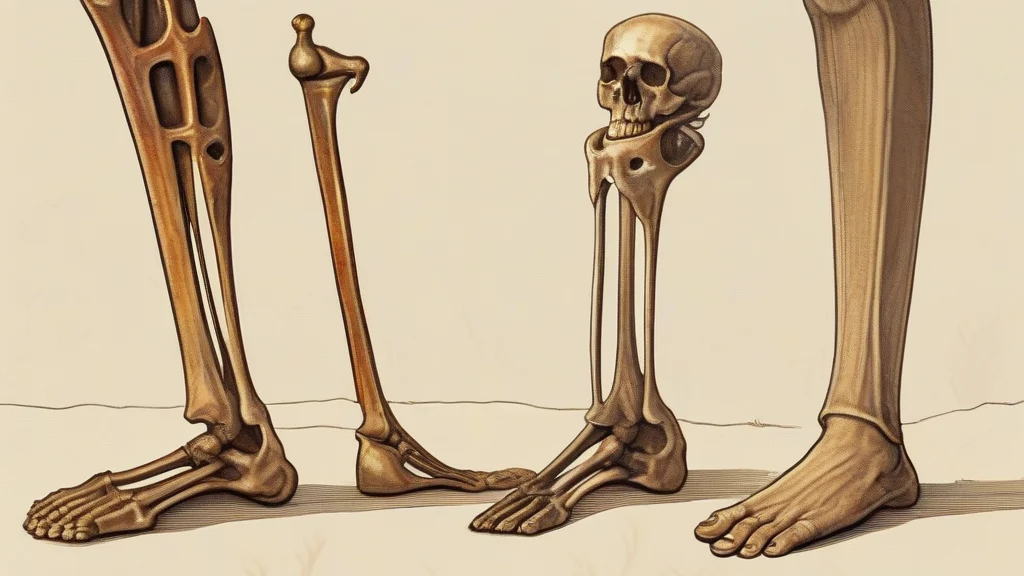
What does fibula mean?
The fibula is the slenderer of the two bones of the human lower leg, lying on the outer side of the limb and running parallel to the thicker tibia. Although it helps stabilise the ankle and serves as a point of attachment for muscles, it carries relatively little of the body's weight, which is why isolated fractures of the fibula can sometimes be less disabling than injuries to the tibia — though a broken fibula remains one of the most common sports injuries. The word has a second, older meaning: in classical archaeology, a fibula is an ornamental brooch or clasp used to pin garments, familiar from Greek and Roman finds. Both senses derive from the Latin fibula, meaning a clasp or buckle, so called because the narrow bone was thought to resemble such a fastening. Today you will meet the word chiefly in medical reports, anatomy lessons, and museum catalogues.
The outer and thinner of the two bones of the lower leg, extending from the knee to the ankle on the lateral side of the tibia.
"The surgeon inserted a plate to stabilise the fractured fibula."
Standard plural: fibulae or fibulas.
An ancient brooch or clasp, typically of metal, used to fasten a garment.
"A gilded fibula recovered from the burial site dates to the early Iron Age."
Chiefly used in archaeology and classical studies.
'Fibulae' is the traditional Latinate plural, preferred in formal, medical, and archaeological writing; 'fibulas' is widely accepted in everyday contexts.
"Fractures of both fibulae were visible on the radiograph."
The same Latin word named both an ancient safety pin and your calf bone — because to Roman eyes, that thin bone looked like a garment clasp.
Reviewed by Deb Chak, Editor. AI-assisted content curated by RJS Tech Solutions LLP.
Etymology of fibula
Fibula comes directly from Latin fibula, meaning a clasp, brooch, or buckle, ultimately from the root of the verb figere, 'to fix' or 'to fasten'. Roman anatomists applied the term to the slender outer bone of the lower leg, presumably by resemblance to a fastening pin. English adopted the anatomical term in the late seventeenth century, while the archaeological sense preserves the original Latin meaning. The same Latin root figere produced many English relatives, including fix, fixture, and transfix.
How fibula is actually used
The anatomical sense dominates modern usage; the archaeological sense appears mainly in academic and museum contexts. The standard plural is 'fibulae'; 'fibulas' is also accepted in general use.
Easily confused with fibula
The tibia is the thicker, inner, weight-bearing shin bone, while the fibula is the slender outer bone that bears little weight.