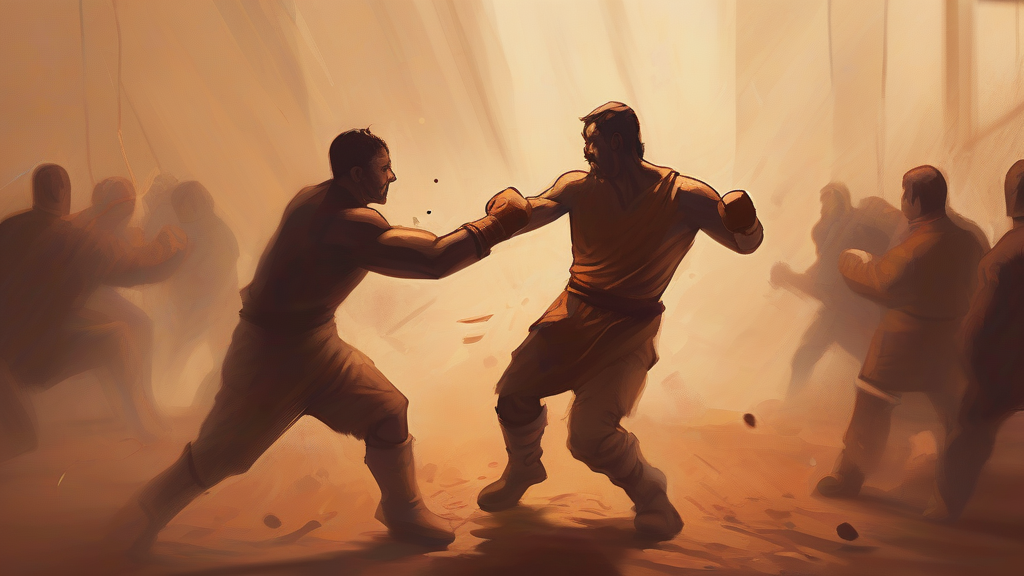
What does fight mean?
To fight is to engage in combat or struggle, either physically — as soldiers, boxers, or brawlers do — or figuratively, as when people fight disease, injustice, or for a political cause. The word covers everything from an actual pitched battle to a heated argument between friends, making it one of English's most versatile verbs of conflict. As a noun, a fight is any such contest or quarrel, from a championship boxing match to a brief squabble. Its connotation depends heavily on context: literal fighting suggests violence and danger, but figurative uses are overwhelmingly admiring, implying courage, persistence, and moral purpose — we speak approvingly of people who fight cancer or fight for their rights. Derived forms include "fighter" and "fighting," and its irregular past tense is "fought." Rooted in ancient Germanic, the word has been central to English expressions of struggle since the language's earliest records.
To take part in a physical struggle or battle; to contend against an opponent using force, argument, or determined effort.
"They fought the proposal all the way through parliament."
Often followed by "for," "against," "over," or "with" depending on the relationship to the object of struggle.
An act or instance of fighting; a battle, contest, bout, or quarrel.
"The neighbours' argument escalated into a shouting fight on the front lawn."
In sporting contexts, especially boxing, "a fight" refers to a scheduled competitive match.
Regular plural; used of repeated battles, bouts, or quarrels, as in street fights or title fights.
"The two rivals have met in three championship fights."
"Fight" descends from an ancient root that also gave us the Latin word for comb — because in early Germanic, combat was imagined as plucking and tearing like teeth through tangled hair.
Reviewed by Deb Chak, Editor. AI-assisted content curated by RJS Tech Solutions LLP.
Etymology of fight
Fight comes from the Old English verb "feohtan," meaning to combat or strive, which traces back to Proto-Germanic *fehtan. The same Germanic root survives in modern Dutch "vechten" and German "fechten" (the latter now used especially of fencing). More remarkably, this root appears to derive from an Indo-European base meaning to pluck or tear out, which also produced the Latin "pectere," to comb — so "fight" is a distant cousin of words for combing hair, reflecting an image of tearing at an opponent. The noun "fight" arose in Old English from the verb, and the irregular past tense "fought" has been stable for over a millennium.
Related word forms
How fight is actually used
"Fight" is common in both formal and informal registers, but its figurative uses — fighting illness, fighting for justice — carry strongly positive connotations of courage and determination, whereas physical fighting often carries negative connotations of violence. In British English, "fight" as a noun can also mean a boxing match, as it does in American English. The past tense is the irregular form "fought."
Easily confused with fight
"Flight" means the act of flying or fleeing, while "fight" means combat or struggle — they differ only by their initial consonant.