What does filo mean?
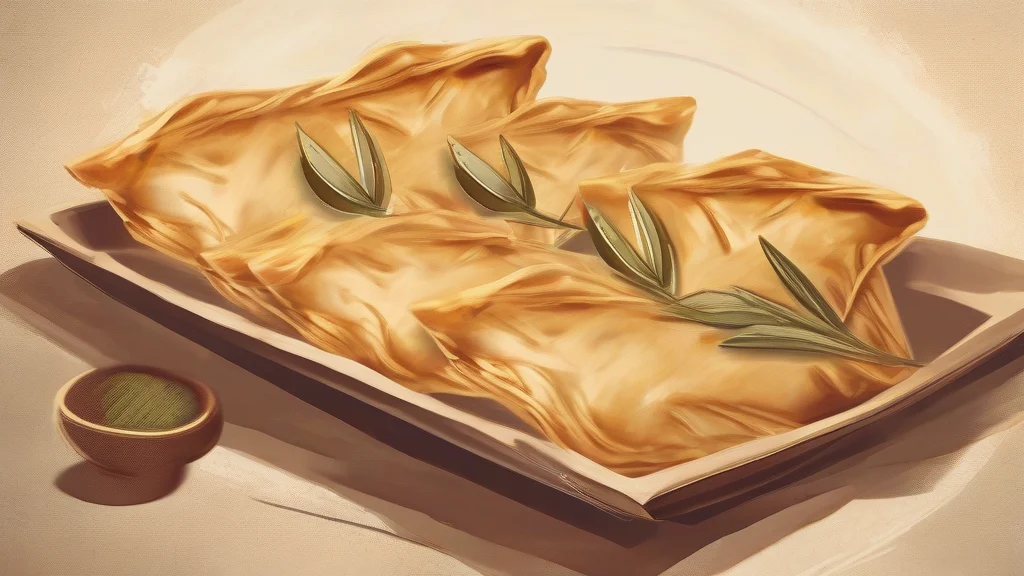
Filo is an extremely thin, almost translucent pastry dough central to the cuisines of Greece, Turkey, the Balkans, and the Middle East. Sold in stacked sheets that are brushed with butter or oil and layered before baking, it puffs and crisps in the oven into a delicate, shattering crust. It forms the basis of celebrated dishes such as baklava, spanakopita, and börek, and lends itself equally to sweet and savory fillings. The name comes from the Greek word for 'leaf,' a fitting description of its gossamer thinness. In recipes, filo is usually treated as an uncountable material — cooks speak of 'sheets of filo' rather than counting individual filos. A separate, unrelated use appears in computing, where FILO (an acronym for 'First In, Last Out') names a stack-like ordering principle, identical in meaning to LIFO. For most readers, however, filo belongs firmly in the kitchen, where its crispness and lightness make it one of the most distinctive pastries in the world.
nounA kind of very thin, paper-like pastry dough used in layered baked dishes such as baklava and spanakopita; also a dish made with this pastry.
- A very thin, sheet-like pastry dough used in Greek, Balkan, and Middle Eastern cooking, typically brushed with butter or oil and baked in many layers.
- (Computing, as the acronym FILO) An ordering principle in which the first item added is the last to be removed, synonymous with LIFO.
"She layered the sheets of filo with butter and chopped nuts before baking the baklava."
"Brush each sheet of filo with melted butter before adding the spinach filling."
"The dessert was wrapped in golden, shatteringly crisp filo."
Rarely pluralized; filo is normally used as an uncountable mass noun, with quantity expressed in 'sheets' or 'layers'.
"The freezer was stocked with several filos for the holiday baking."
Filo's name literally means 'leaf' in Greek — because each sheet of this pastry is rolled as thin as one.
Reviewed by Deb Chak, Editor. AI-assisted content curated by RJS Tech Solutions LLP.
Etymology of filo
The word filo derives from modern Greek 'phyllo' (φύλλο), meaning 'leaf,' reflecting the paper-thin sheets of dough it names. It entered English cookery vocabulary in the twentieth century as Greek and Balkan dishes became widely known in Britain and North America. The spelling 'phyllo,' which preserves the original Greek form more exactly, is common in American usage. The Greek root also gives us scientific terms such as 'chlorophyll,' the green pigment of leaves.
How filo is actually used
In cookery writing the word appears both uncountably (as a substance, 'roll out the filo') and countably ('two filos'), though it is most often treated as an uncountable mass noun; British usage favors 'filo pastry,' while North American packaging often uses 'phyllo.' The computing acronym is always capitalized and unrelated etymologically.
Easily confused with filo
As a capitalized acronym, FILO ('First In, Last Out') describes a data-handling order in computing, entirely unrelated to the pastry.
Phyllo is simply an alternative spelling of the same pastry name, closer to its Greek source, not a different food.