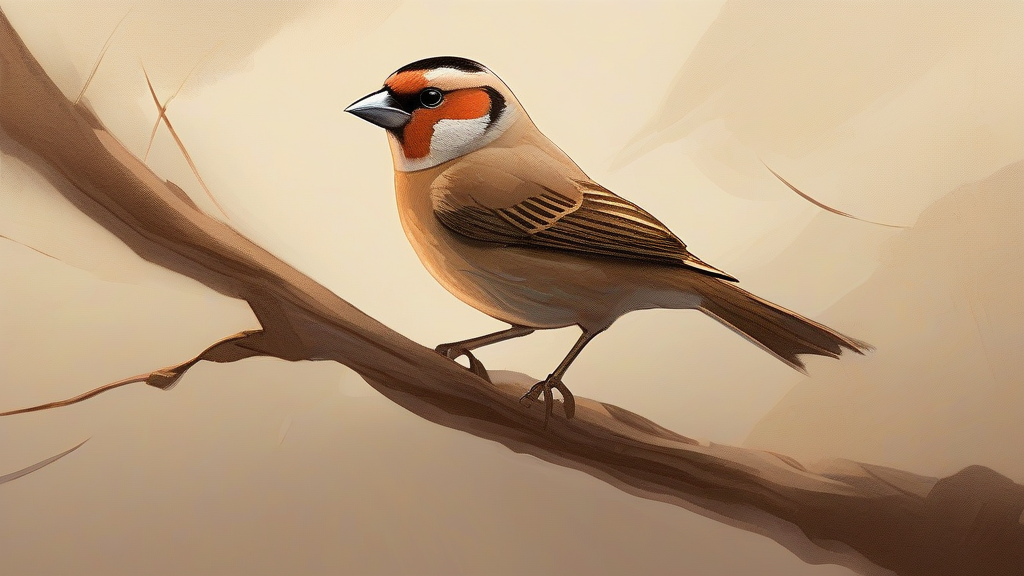
What does finch mean?
A finch is a small songbird belonging to the family Fringillidae, a widespread group that includes familiar species such as the chaffinch, goldfinch, greenfinch, and crossbill. Finches are best recognised by their stout, conical bills, which are specialised for cracking seeds, their principal food, though many also eat buds, fruit, and insects. They are found across most of the world and are frequent visitors to gardens and bird feeders, where their lively behaviour and, in some species, bright plumage make them popular with birdwatchers. The term is also used more loosely for birds outside Fringillidae that have converged on a similar form, most famously Darwin's finches of the Galápagos Islands, whose varied beaks helped inspire the theory of evolution by natural selection — although those birds are now classified as tanagers. In English, "finch" functions as an ordinary countable noun with the regular plural "finches," and it carries no particular connotation beyond its natural association with small, cheerful, seed-eating birds.
nounA small to medium-sized perching songbird of the family Fringillidae, typically having a stout conical bill adapted for eating seeds. The name also extends informally to various superficially similar birds, such as Darwin's finches of the Galápagos.
- Any small seed-eating songbird of the family Fringillidae, including chaffinches, goldfinches, greenfinches, and crossbills.
- Informally, any of various unrelated birds resembling true finches, such as Darwin's finches of the Galápagos or the waxbills sometimes called finches.
"A goldfinch — one of the most colourful finches in Britain — feasted on the teasel heads."
"The feeder was mobbed by chaffinches and greenfinches all morning."
"Darwin noticed that each island in the Galápagos had its own distinct kind of finch."
Regular plural formed with -es because the singular ends in the /tʃ/ sound; standard in both British and American English.
"The hedgerows were alive with finches throughout the winter."
The birds that made Darwin famous weren't actually finches at all — 'Darwin's finches' are tanagers that simply evolved into finch-like forms on the Galápagos Islands.
Reviewed by Deb Chak, Editor. AI-assisted content curated by RJS Tech Solutions LLP.
Etymology of finch
The word "finch" descends from the Old English "finc", which in turn comes from a Proto-Germanic root often thought to echo the bird's call, making its ultimate origin imitative rather than descriptive. It has direct counterparts in other Germanic languages, such as German "Fink" and Dutch "vink", reflecting a shared ancestral word rather than borrowing. The term has been in continuous use in English since before the Norman Conquest, making it one of the older bird names in the language.
How finch is actually used
"Finch" is a neutral, standard term used in both everyday birdwatching talk and ornithological writing. In casual usage it is often applied loosely to any small songbird with a thick bill, even ones ornithologists place elsewhere; the plural "finches" is regular.
Easily confused with finch
"Flinch" is a verb meaning to draw back suddenly in fear or pain, while "finch" is a noun naming a type of seed-eating songbird.