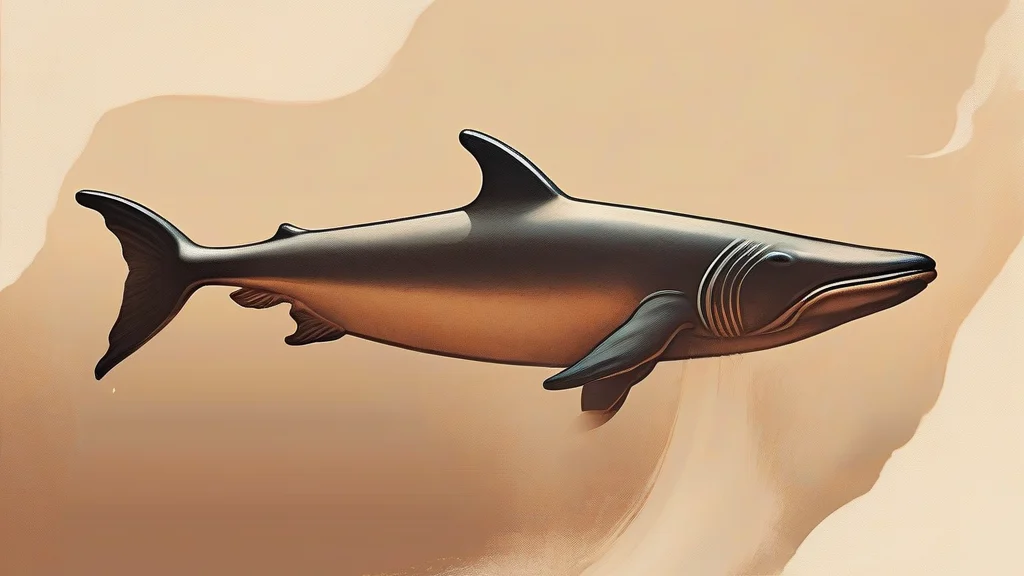
What does finlike mean?
Finlike is an adjective used to describe anything that resembles a fin in shape, form, or character. The word combines the noun fin — the flattened, paddle-like limb of fish, whales, and other aquatic animals — with the common English suffix -like, which signals resemblance. It appears most frequently in scientific and technical description: biologists might describe a cuttlefish's lateral membranes or a fossil creature's dorsal sail as finlike, while engineers use the term for hydrofoils, stabilizers, and heat-dissipation vanes whose broad, flat profile echoes a fin's silhouette. The word is purely descriptive and neutral in tone, carrying neither praise nor criticism; it simply signals visual or functional similarity to a fin. Finlike is useful precisely because it lets writers borrow the familiar image of a fin to characterize unfamiliar shapes, whether in anatomy, paleontology, architecture, or machine design, making it a compact bridge between natural form and human observation.
adjectiveResembling a fin in shape, form, or function — typically describing a structure, projection, or appendage that is thin, broad, and flat like the fin of a fish, whale, or other aquatic animal.
- Resembling a fin in shape or form, especially as a descriptive term for biological structures, anatomical projections, or engineered components.
"The dinosaur's spine was crowned with finlike sails that may have regulated its body temperature."
"The cuttlefish propels itself with undulating finlike membranes running along the sides of its body."
"Architects topped the pavilion with finlike panels that shade the glass roof from the afternoon sun."
From Spinosaurus's sail-backed spine to the hydrofoils on racing yachts, engineers and evolution alike keep reinventing the same finlike shape — because it works.
Reviewed by Deb Chak, Editor. AI-assisted content curated by RJS Tech Solutions LLP.
Etymology of finlike
Finlike is a compound formed from the Old English noun 'finn' (the limb of a fish), which survives today as fin, combined with the suffix '-like', derived from Old English 'gelīc', meaning 'having the same form as'. The -like suffix has produced a large family of resemblance adjectives in English, such as childlike, lifelike, and warlike, all following the same pattern of pairing a concrete noun with a signal of similarity. As a relatively modern descriptive formation rather than an ancient word, finlike arose through this established English pattern of compound adjective creation, and its cognates are best understood as the many other '-like' adjectives sharing the same suffix lineage rather than words tracing back to a single continental root.
How finlike is actually used
Finlike is almost always used attributively or predicatively to describe physical form rather than function alone, appearing most often in scientific, technical, and nature-writing contexts. It carries no strong positive or negative connotation; it is a neutral, descriptive compound formed with the -like suffix, and its register is generally informative rather than casual.
Easily confused with finlike
Finicky means excessively fussy or particular about details, whereas finlike means resembling a fin in shape or form.
Finned describes something that actually has fins, while finlike describes something that merely resembles a fin without being one.